When it comes to ordering rigid PVC profiles, many businesses make the mistake of focusing only on the profile shape, material, and price. However, what they fail to realise is the fact that even a small difference in size can affect how the profile fits into a product, system, or structure.
Since rigid PVC profiles are often made to fit with other parts, details such as width, height, wall thickness, and tolerance need to be clear before production begins. A profile that looks correct may still cause problems if its key dimensions do not match the required measurements.
While you can find a plethora of companies offering custom PVC profiles for UAE projects, finding a manufacturer that can consistently meet your required dimensions can be a challenge.
Nonetheless, by doing in-depth research and checking a few key details before placing your order, you can easily reduce the risk of fit and dimensional problems and make a more informed choice.
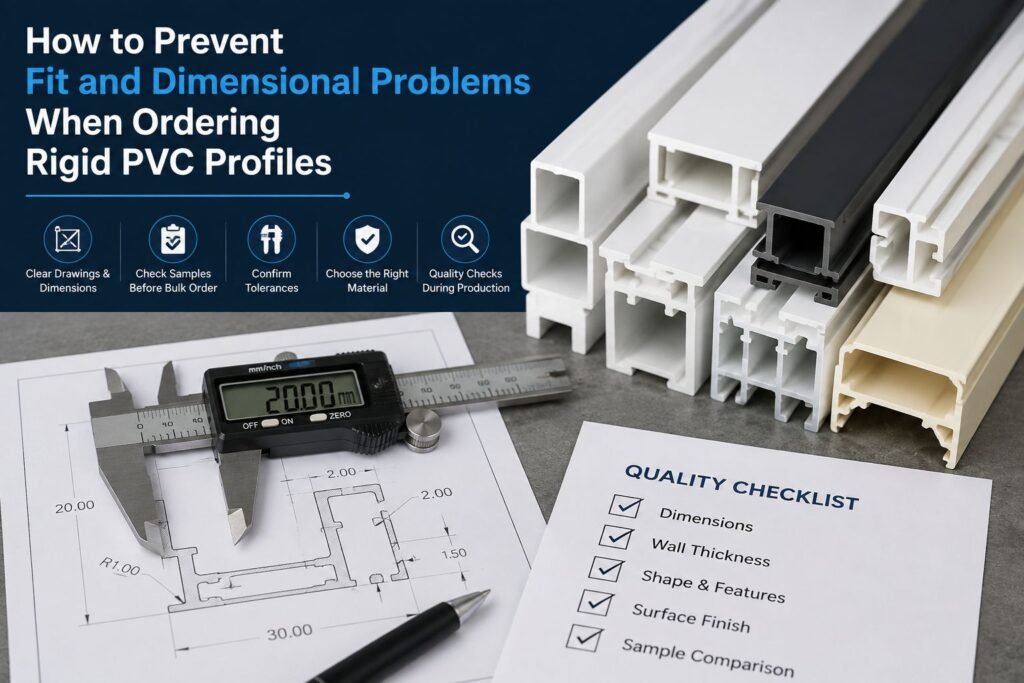
5 Tips to Avoid Fit and Dimensional Problems with Rigid PVC Profiles
Provide Clear Profile Dimensions and Drawings
To ensure the manufacturer can produce a profile that meets your required dimensions and fits the intended application, you should provide clear profile dimensions and drawings before placing an order. Giving only a basic description of the required profile may not provide enough information to produce the right size and shape.
Start by listing all the key dimensions of the rigid PVC profile. These may include its overall width, height, length, wall thickness, and internal dimensions. If the profile has curves, angles, slots, holes, or other features, these should also be shown clearly.
A technical drawing can be very useful for custom rigid PVC profiles. It can show the exact shape and size of the profile and help the manufacturer understand how each part should be made. If a CAD file is available, it can also be shared along with the drawing.
Some details to include are:
- Overall Dimensions: Provide the required width, height, and length.
- Wall Thickness: State the required thickness for each part of the profile where it differs.
- Internal Dimensions: Include openings, channels, or spaces that need to meet a set size.
- Profile Shape: Show curves, angles, corners, slots, and other design features.
- Cut Length: State the required length of each finished piece.
- Dimensional Tolerance: Mention the allowed size variation for key dimensions.
Do not rely only on a basic description such as “a 20 mm PVC profile.” A full drawing and clear measurements give the manufacturer more useful information.
If the profile needs to fit with another component, share the dimensions of the mating part as well. This can help the manufacturer understand which measurements are most important for the final fit.
Check a Sample Before Placing a Large Order
In addition to providing clear profile dimensions and drawings, make sure you also check a sample before placing a large order. Reviewing a sample will let you see whether the actual rigid PVC profile matches the required dimensions and fits the intended application.
Once the sample is received, compare it with the required specifications. Check the dimensions that affect the final fit first. If the profile needs to connect with another part, test the actual fit as well.
A sample check should include:
Sample Check | What to Look For |
Dimensions | Width, height, length, and other key measurements |
Wall thickness | Whether the thickness matches the required drawing |
Shape | Whether curves, corners, slots, and other features match |
Fit | Whether the profile connects or fits as required |
Colour | Whether the colour matches the required specification |
Surface finish | Whether the finish meets the agreed requirement |
If the sample does not fit correctly, discuss the issue with the manufacturer before placing the large order.
Checking a sample before placing a large order gives you a chance to find fit or dimensional issues early. This can help you avoid rework, delays, and profiles that cannot be used as planned.
Check Tolerances Before Production
No manufacturing process can always produce every profile at one exact measurement. Small variations may occur during extrusion. This is why understanding the dimensional tolerance, or the allowed variation from the required measurement, is essential before placing an order.
For example, if a profile has a required width of 20 mm, the acceptable range may allow a small variation above or below 20 mm. The exact tolerance will depend on the profile design, material, size, and application.
Tolerance becomes more important when a rigid PVC profile needs to fit into another part. A small difference may not matter for one application but can cause a fit issue in another.
Before production, discuss the required tolerance for the profile with the manufacturer. Make sure the agreed tolerance is clearly stated in the drawing or order details. This gives the manufacturer a clear size range to work within and helps avoid confusion about what measurements are acceptable.
Discussing the dimensional tolerance in advance will help you ensure that the finished rigid PVC profiles stay within the required size range and fit the intended application.
Choose the Right Material for the Profile
The material used for a rigid PVC profile can affect its final dimensions, strength, and ability to fit the intended application. Choosing a material that suits the profile design and its use can help reduce fit and performance issues.
The right material depends on how the rigid PVC profile will be used. For example, a profile for construction may need different strength and durability than one used for lighting, refrigeration, furniture, or water systems. Share the intended use with the manufacturer so the material can be selected accordingly.
The required material, strength, hardness, colour, and surface finish should also be clear. If there is a set material grade or specification, provide it to the manufacturer. If the material has not been decided, discuss the application with the manufacturer to find a suitable option.
Other details to confirm include:
- PVC Material or Grade: State the required material or discuss suitable options.
- Strength Requirements: Explain whether the profile needs to handle load, impact, or other stress.
- Colour: Provide the required colour or colour reference.
- Surface Finish: State whether the profile needs a smooth, matte, or other finish.
- Application: Explain how the profile will be installed or used.
- Environmental Needs: Mention if the profile will be exposed to heat, moisture, chemicals, or other conditions.
By choosing the right material based on the profile’s design and intended use, you can reduce the risk of size, fit, and performance issues after production.
Confirm Quality Checks During Production
No matter how carefully the profile requirements are defined or how experienced and skilled the manufacturer is, if there are no proper quality checks during production, dimensional problems can still occur. Regular quality checks help confirm that the finished rigid PVC profiles meet the required size, shape, and other specifications.
Before placing an order, make sure you understand how the manufacturer checks the profiles during production. Ask about the checks carried out at different stages and how the results are compared with the required specifications.
Common quality checks may include:
- Dimension Checks: Key measurements are checked against the required specifications.
- Wall Thickness Checks: The thickness is checked to make sure it stays within the required range.
- Shape Checks: The profile is checked for changes in curves, angles, slots, and other features.
- Surface Inspection: The profile is checked for visible marks, defects, or finish issues.
- Sample Comparison: Production profiles can be compared with the approved sample or drawing.
For repeat orders, regular quality checks are important for keeping the profiles consistent from one order to the next. The same agreed specifications should be used as a reference during each production run.
Choosing a manufacturer with a clear quality check process can help identify dimensional or fit issues during production, before the profiles are shipped.
M3 Extrusion: Rigid PVC Profiles for Different Applications
M3 Extrusion provides rigid PVC profiles for businesses across different industries. The company can produce profiles in different shapes, sizes, and designs based on customer requirements.
Their rigid PVC profiles are suitable for applications in construction, lighting, refrigeration, automotive, furniture, packaging, and water systems.
M3 Extrusion also supports export orders for overseas buyers. Shipping terms such as FOB and CIF are available, and air freight can be arranged for urgent orders where needed.
The company can support businesses with:
- Custom Rigid PVC Profiles: Profiles can be made based on required shapes, dimensions, and designs.
- Dimensional Requirements: Profiles can be produced to meet specified sizes and profile requirements.
- Quality Checks: Product checks help maintain the required dimensions and profile quality.
- Export Support: Support is available for overseas orders and shipping needs.
- Long-Term Supply: Ongoing rigid PVC profile supply can be supported for businesses with repeat requirements.
By offering high-quality rigid PVC profiles based on specific size and design requirements, M3 Extrusion can help businesses get profiles that fit their intended applications and support their project needs.
Conclusion
Fit and dimensional problems with rigid PVC profiles can cause delays, extra work, material waste, and added costs. Many of these issues can be reduced by taking time to check the profile requirements and production details beforehand.
By keeping the above-mentioned tips and tricks in mind, you can easily compare manufacturers, confirm your profile requirements, and reduce the risk of receiving profiles that do not fit your application.
Are you looking for rigid PVC profiles made according to your required dimensions? M3 Extrusion offers custom rigid PVC profiles in different shapes, sizes, and designs to meet your application requirements. Contact us to discuss your requirements.
Frequently Asked Questions
What information should be provided when ordering rigid PVC profiles?
When ordering rigid PVC profiles, provide the manufacturer with the required dimensions, wall thickness, profile shape, tolerance, material, colour, surface finish, application, and order quantity. A technical drawing or CAD file should also be shared when available to show the exact profile design and measurements.
What causes rigid PVC profiles to have dimensional problems?
Dimensional problems can result from unclear specifications, unsuitable tolerances, changes in profile design, or poor quality checks during production. Clear drawings and agreed measurements can help reduce these issues.
How can rigid PVC profile dimensions be checked during production?
Manufacturers may use tools such as callipers, gauges, and other measuring equipment to check key dimensions. The results can be compared with the approved drawing, specifications, or sample to help maintain consistency.
Can rigid PVC profiles be made to custom dimensions?
Yes, rigid PVC profiles can be produced in custom shapes and dimensions based on the application and design requirements. Buyers can provide technical drawings, CAD files, measurements, and other specifications to help the manufacturer produce the required profile.