While there is no denying that modern insulated glass windows offer strong insulation and improved comfort, they struggle to prevent heat loss at the edges of the glass.
Even with strong glass and tight sealing, the edge area often behaves differently from the centre. Not to mention, it also loses heat faster and reacts quickly to outside temperatures. This creates uneven cooling across the glass surface.
When this happens, warm indoor air meets a cold glass edge. Moisture in the air turns into water droplets. This is why you often see fogging or wet patches near window frames, especially in colder weather.
This issue does not stay small. Over time, it affects visibility, insulation, and overall window life. The glass may still look fine, but its performance drops from the edges first.
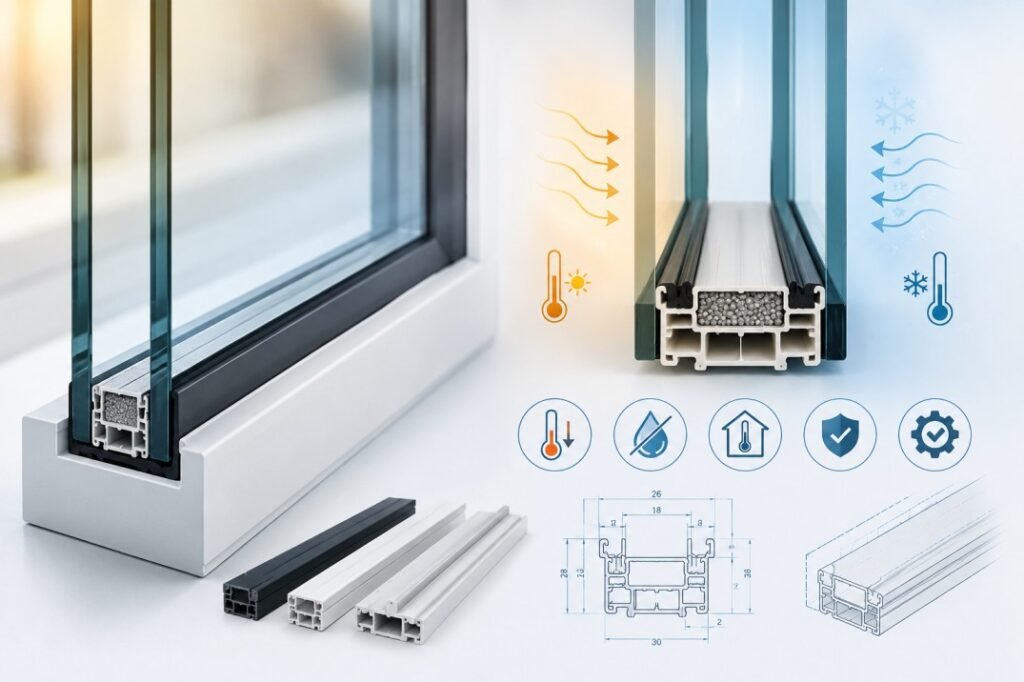
They sit between glass panes and help manage heat flow at the edge. Not only do warm-edge spacer solutions improve insulation between the glass panes, but they also help reduce heat loss at the edges where condensation normally starts. By keeping the edge warmer and more stable, they reduce condensation and support better insulation across the entire unit.
What Are Warm Edge Spacers?
A warm edge spacer is a thin, non-metallic bar placed between glass panes in double and triple-glazed windows. It sits along the edge of the glass unit and helps keep a fixed gap between the panes. This gap holds air or gas that slows heat transfer and improves insulation.
The spacer also supports the edge seal that holds the glass unit together. A steady and even spacer helps the seal stay tight across the full edge. This reduces the chance of air or moisture entering the space between panes and helps keep the unit stable over time.
It also helps control heat flow at the edge of the glass. Since edges lose heat faster than the centre, this area often becomes cold and prone to condensation. Warm edge spacers reduce this heat loss by using low heat transfer materials like PVC. This keeps the edge temperature more balanced and helps prevent cold ring formation.
5 Reasons Warm Edge Spacers Are Important in Modern Insulated Glass Windows
By controlling heat loss at the glass edges and keeping the insulated glass structure stable, warm edge spacers help improve insulated glass window’s performance.
Because of this stability, the glass surface stays more evenly cooled and temperature shifts inside the unit are reduced. It also reduces the risk of condensation at the edges, where temperature drops are most common.
These effects make a clear difference in how the window performs in daily use, especially in changing weather conditions. Here are five reasons why warm edge spacers are important in modern insulated glass windows.
Reduce heat loss at edges
One of the major benefits of warm edge spacers is the fact that they lower heat loss at the glass edges in insulated windows.
Heat loss in insulated glass windows is not uniform. The centre stays stable, while the edges lose heat much faster. This happens because edge materials conduct heat more easily and react quickly to outside temperature shifts.
Warm edge spacers slow down this process and improve temperature stability at multiple levels:
- They reduce how fast heat escapes from inside the room through the glass edge.
- They limit sharp temperature drops during cold weather.
- They help keep the edge temperature closer to indoor conditions.
Because of this, the window surface stays more balanced. Instead of a cold ring forming near the edges, the temperature difference becomes smaller and more controlled.
Improve insulation performance
In addition to reducing heat loss at the edges of insulated glass windows, you can improve window insulation with warm-edge spacers by limiting heat transfer at the glass edges where energy loss is highest.
Insulated glass windows depend on a sealed space between panes. This space holds air or gas that slows heat transfer.
Warm edge spacers support this setup in more than one way:
- They keep the glass panes at a fixed distance, which protects the sealed cavity.
- They support the edge seal, which blocks outside air and moisture.
- They help maintain gas or air inside the unit for longer periods.
When these functions stay stable, the insulation system works better. Heat loss slows down, and indoor temperature stays more consistent.
Reduce condensation risk
By reducing heat loss at the edges of insulated glass windows and keeping the glass surface more stable in temperature, warm edge spacers also help lower condensation risk.
This is important because condensation does not start randomly. It forms when warm indoor air meets a cold glass surface, and the edge area is usually the first to drop in temperature. Once the surface cools, moisture in the air begins to collect as water droplets.
Warm edge spacers help control this process by keeping the edge temperature more stable. They reduce sharp cooling at the border of the glass and limit the conditions that trigger moisture buildup.
The table below shows how warm edge spacers change key factors that affect condensation in insulated glass windows:
Factor | Without warm edge spacers | With warm edge spacers |
Edge temperature behavior | Drops quickly during cold conditions | Stays more stable and closer to indoor temperature |
Heat movement | Faster heat escape at glass edges | Slower and more controlled heat loss |
Moisture formation | Water droplets form easily on cold spots | Condensation risk is reduced |
Surface condition | Fogging and damp patches near edges | Clearer and drier glass surface |
Temperature balance | Strong difference between centre and edges | More even temperature across the glass |
With better temperature control at the edges, warm edge spacers help reduce the chances of condensation forming. This leads to clearer glass and better day-to-day window performance.
Improve insulation performance
By maintaining a stable gap between glass panes and reducing heat loss at the edges, warm edge spacers help improve insulation performance in insulated glass windows.
Insulated glass windows depend on a sealed space between panes. This space holds air or gas that slows heat transfer.
Warm edge spacers support this setup in more than one way:
- They keep the glass panes at a fixed distance, which protects the sealed cavity.
- They support the edge seal, which blocks outside air and moisture.
- They help maintain gas or air inside the unit for longer periods.
When these functions stay stable, the insulation system works better. Heat loss slows down, and indoor temperature stays more consistent.
Reduce cold spots
Since warm edge spacers reduce heat loss at the glass edges, they also play a key role in reducing cold spots on the glass surface.
Cold spots form when parts of the glass lose heat faster than others. These spots are most common near edges, where temperature drops are quicker and more uneven.
In insulated glass windows, this problem is often caused by metal spacers that allow faster heat loss at the edge area. Because heat moves out faster from these points, small cold zones start to form on the glass surface.
Warm edge spacers help reduce these effects by limiting heat loss at the glass edge, which results in:
- Less temperature difference between edge and centre areas.
- A more uniform glass surface temperature.
- Reduced moisture buildup in localised cold spots.
When the surface is more balanced, condensation risk drops and the glass stays clearer.
Support seal strength
Another major benefit of warm edge spacers is the fact that they help improve how the seal works in insulated glass units.
The seal in an insulated glass unit holds the entire structure together. It keeps the glass panes fixed in place and protects the air or gas filled inside the unit.
Warm edge spacers support this seal in key ways:
- They help keep even pressure along the glass edges.
- They reduce movement between the panes during temperature changes.
- They support long-term shape stability of the glass unit.
Without this support, the seal can weaken over time. This may allow gas to leak out or moisture to enter the unit, which can cause internal fogging that cannot be cleaned.
By keeping the edge structure stable, warm edge spacers help extend the life of the glass unit and maintain steady performance over time.
Frequently Asked Questions
Are warm edge spacers better than metal spacers?
Yes. Warm edge spacers reduce heat loss more than metal spacers. This helps keep the glass edges warmer and lowers the risk of condensation.
Do warm edge spacers affect the strength of insulated glass units?
Yes. Warm edge spacers help keep the glass panes evenly spaced and stable. This reduces stress on the edges and supports a stronger, longer-lasting sealed unit.
Do warm edge spacers need special maintenance?
No. Warm edge spacers are sealed inside the glass unit. They do not need cleaning or direct care once the window is installed.
Where are warm edge spacers most commonly used?
They are widely used in residential windows, commercial buildings, and industrial glazing systems where double or triple-glazed insulated glass units are installed.
Do warm edge spacers work in double and triple-glazing?
Yes. They are used in both systems. They improve insulation and reduce moisture problems in double and triple-glazed units.
Conclusion
Warm edge spacers play an important role in maintaining steady insulation performance in modern insulated glass windows. They reduce heat loss at the edges, lower condensation risk, and improve insulation stability across the full unit.
They also help reduce cold spots and support strong seal performance over time. This results in better window efficiency and longer service life.
Are you looking for reliable warm edge spacer profiles for insulated glass systems? M3 Extrusion offers high-quality warm edge spacer profiles designed to improve insulation, reduce condensation, and support long-term window performance.