Whether you want to improve the safety of industrial electrical systems or lower the risk of damage and breakage in electronic equipment, using Noryl profiles can be an ideal option. Not only do these profiles offer strong insulation and heat resistance, but they also help maintain shape and strength under continuous use in industrial environments.
Unlike many basic plastic materials, Noryl profiles provide a better balance between durability, electrical safety and long-term stability. This makes them a preferred choice in electrical equipment where performance and reliability cannot be compromised.
With the rise in popularity of Noryl profiles, you can find a plethora of plastic extrusion companies in India offering different grades and design options.
By offering strong insulation, heat resistance, and good dimensional stability, Noryl profiles help meet the demands of modern industrial electrical and electronic systems.
Top 5 Benefits of Using Noryl Profiles in Electrical and Electronic Equipment
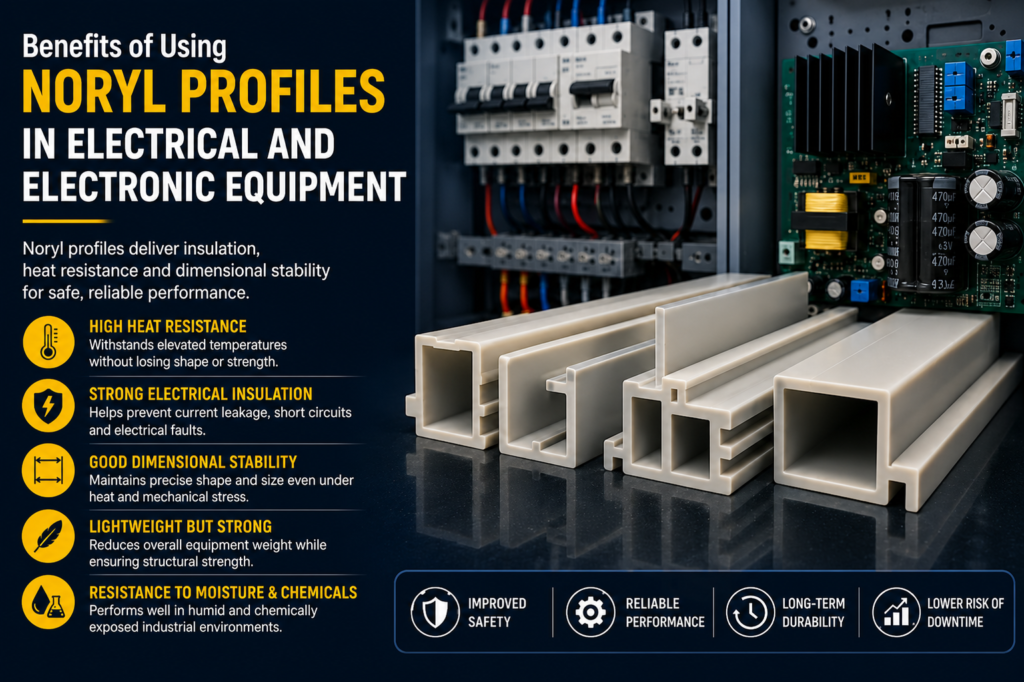
Since Noryl profiles offer a combination of heat resistance, dimensional stability and electrical insulation, they are widely used in electrical and electronic equipment across industries. They help improve safety, support reliable performance, and maintain their properties under demanding operating conditions.
Here are the five major benefits of using Noryl profiles in electrical and electronic equipment.
1. High Heat Resistance
One of the major benefits of using Noryl profiles in electrical and electronic equipment is the fact that they offer high heat resistance. These profiles can withstand elevated temperatures without losing their shape or structural integrity, making them suitable for equipment that operates under continuous heat exposure.
Noryl profiles support the reliable operation of electrical and electronic equipment by:
- Retaining their shape under elevated temperatures
- Supporting consistent operation during continuous use
- Performing well in equipment exposed to regular heat buildup
In industrial applications, maintaining dimensional stability is important for proper fit and function. Noryl profiles help keep components aligned as well as structurally stable, even in environments where heat is a constant factor.
As a result, they are commonly used in electrical housings, control panels, and other equipment where heat resistance is essential.
2. Strong Electrical Insulation
In addition to offering high heat resistance, Noryl profiles also provide strong electrical insulation. This is important in electrical and electronic equipment where safe separation between conducting parts is needed.
They help block unwanted electrical flow between components, which reduces the risk of short circuits and equipment failure.
In industrial electrical and electronic equipment, Noryl profiles help maintain stable insulation performance even during long operating cycles. This supports consistent protection of internal parts and helps reduce the chance of electrical faults over time.
Because of this stability, Noryl profiles are widely used in applications where reliable insulation and long service life are required under continuous electrical load.
3. Good Dimensional Stability
Since Noryl profiles have strong resistance to heat and mechanical stress, they maintain their shape and size over time. They do not expand or shrink easily under changing temperature or pressure conditions.
This makes them dependable for applications where even small size changes can affect performance. Not to mention the fact that it also helps reduce fitting issues during assembly in industrial systems. Because of this, Noryl profiles support smoother integration of components in electrical and electronic equipment.
4. Lightweight but Strong
Industrial electrical as well as electronic equipment often needs materials that are strong but not heavy. Heavy parts can increase load inside systems, make installation difficult and limit design flexibility. Noryl profiles offer a balanced mix of lightweight and strength, making them well-suited for electrical and electronic equipment used in industrial setups.
This helps reduce the overall load on electrical panels and enclosures without affecting structural strength. It also makes handling easier during the assembly of electronic systems.
In larger equipment, lower weight reduces stress on mounting structures and internal supports. At the same time, strength ensures stable performance during continuous operation.
This balance makes Noryl profiles suitable for electrical panels, electronic housings, device frames, and internal support components.
5. Resistance to Moisture and Chemicals
Because Noryl profiles have low moisture absorption and a strong ability to withstand chemical exposure, they resist damage caused by humidity and industrial chemicals in electrical and electronic equipment. They do not absorb moisture easily, which helps maintain strength in damp conditions.
They also remain stable when exposed to many industrial chemicals, which helps preserve surface quality and structural integrity over time.
Noryl Profiles vs Other Common Electrical Insulation Materials
When compared with other commonly used electrical insulation materials in industrial settings, Noryl profiles offer a more balanced mix of heat resistance, strength, and electrical safety. Since Noryl profiles are designed for stable performance under heat, load, and long operating cycles, they are widely used in electrical and electronic equipment.
The table below shows a clear comparison between Noryl profiles and other commonly used insulation materials in industrial settings.
Property / Feature | Noryl Profiles | General Thermoplastics | Basic Electrical Plastics | Standard Engineering Plastics |
Heat Resistance | High | Low | Medium | Medium to High |
Electrical Insulation | Strong | Good | Moderate | Good |
Dimensional Stability | Very High | Medium | Medium | High |
Moisture Resistance | Good | Medium | Medium | Good |
Chemical Resistance | Good | Low to Medium | Low to Medium | Medium |
Strength-to-Weight Ratio | High | Medium | Medium | High |
Long-Term Stability | High | Low | Medium | Medium to High |
Frequently Asked Questions
1. Are Noryl profiles suitable for high-voltage equipment?
Yes. Noryl profiles offer strong insulation that helps reduce electrical leakage. This makes them suitable for high-voltage and medium-voltage systems used in industrial applications.
2. Do Noryl profiles change shape under heat?
Noryl profiles do not easily change shape under heat. This makes them suitable for applications where equipment runs hot for extended periods.
3. Can Noryl profiles be used in outdoor electrical systems?
Yes. Noryl profiles handle moisture and environmental exposure well. This makes them suitable for outdoor electrical systems and industrial installations exposed to weather changes.
4. What makes Noryl different from regular plastic materials used in electrical and electronic equipment?
Noryl offers better heat resistance, electrical insulation and strength compared to many standard plastics. This combination makes it more suitable for industrial and electrical applications where stable performance and safety are required in equipment used under heat, load, and continuous operation.
Conclusion
By offering a balance of heat resistance, insulation, stability and durability, Noryl profiles meet the needs of electrical as well as electronic equipment across industries.
They help reduce failure risk, improve safety and support consistent performance in demanding conditions. For industrial applications where reliability matters, material choice plays a key role in long-term success.
Are you looking for reliable Noryl profiles for electrical and electronic equipment? M3 Extrusion offers high-quality Noryl profiles designed for accurate fit, strong performance and consistent industrial standards.