If you have worked on real construction or industrial projects, you already know this problem. The design looks perfect on paper, but when it comes to actual installation, standard components do not fit the way you expected.
Gaps appear, alignment becomes difficult, and small adjustments turn into time-consuming work. This is exactly where rigid PVC extrusion profiles start making a real difference. Instead of forcing your design to match available parts, you get profiles that are built around your requirement.
From what I have seen on factory floors and project sites, switching to rigid PVC profiles is less about material choice and more about solving fit, durability, and long-term performance issues.
What Are Rigid PVC Profiles?
Rigid PVC profiles are hard plastic sections made through extrusion. They are designed to hold their shape and provide structural support in different systems.
You will find them in:
- Window and door frames
- Electrical panels and enclosures
- Façade structures
- Industrial equipment
Unlike flexible plastic, these profiles are built for strength and stability. That is why they are widely used in both PVC profiles for construction and industrial setups.
The Real Problem with Traditional Materials
In many projects, the default choice is still metal or wood. But both come with practical challenges.
From experience, these are the most common issues:
- Metal parts start corroding in humid or outdoor conditions
- Wood expands or deforms over time
- Standard sections do not match custom designs
- Maintenance becomes a recurring cost
This is why many manufacturers are shifting towards custom rigid PVC profiles that solve these problems at the design level itself.
How Custom Rigid PVC Profiles Solve Structural Challenges
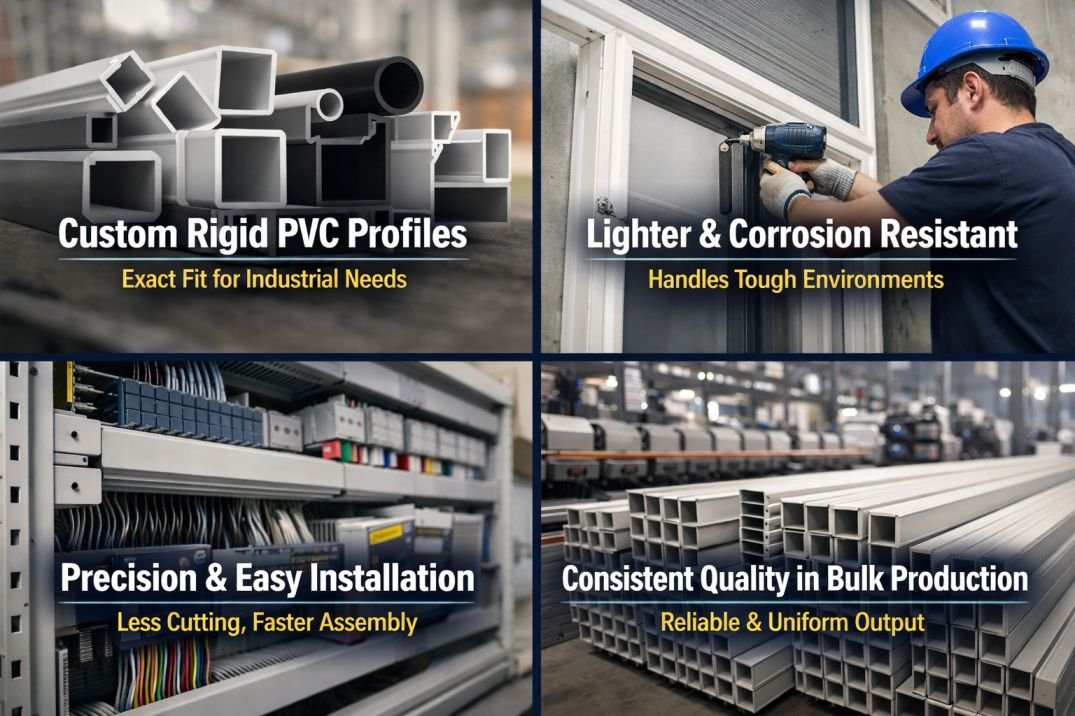
1. Designed for Exact Fit, Not Adjustment
This is the biggest advantage.
With rigid plastic extrusion profiles, you are not limited to standard shapes. The profile is created based on your drawing.
That means:
- Better alignment during installation
- No need for cutting or modification on site
- Faster assembly
In my opinion, this alone saves a lot of time and reduces errors, especially in large-scale production.
2. Balanced Strength Without Extra Weight
Metal gives strength but adds weight. This becomes a problem in applications like panels, frames, or equipment covers.
PVC rigid profiles provide:
- Sufficient structural strength
- Much lower weight compared to metal
- Easier handling during installation
This is especially useful in systems where multiple components are assembled together.
3. Reliable Performance in Tough Conditions
Industrial environments are rarely controlled. Moisture, chemicals, and temperature changes are common.
Industrial PVC profiles are built to handle:
- High humidity
- Chemical exposure
- Temperature variations
Unlike metal, they do not rust. Unlike wood, they do not absorb moisture. This makes them a stable choice for long-term use.
4. Consistency in Large-Scale Production
One thing that often gets ignored is consistency.
With PVC extrusion profiles, you get:
- Same dimensions across every batch
- Uniform quality
- Better compatibility in assembly lines
This is very important for manufacturers producing products in bulk.
5. Cleaner Design and Better Finishing
In many applications, appearance also matters.
Rigid PVC sections offer:
- Smooth surface finish
- Clean edges
- Integrated design features like grooves or channels
This reduces the need for additional finishing work.
Where These Profiles Work Best
From what I have seen, plastic profiles for industrial use are most effective in:
Application | How They Help |
Construction | Window frames, façade systems |
Electrical | Cable management and panel support |
Refrigeration | Door frames and sealing sections |
Machinery | Guides and protective covers |
These applications show how flexible and practical these profiles are across industries.
Practical Insight: What Works and What Fails
Let me be honest here.
What usually works:
- Profiles designed based on actual usage conditions
- Proper material selection (PVC grade matters)
- Working with a manufacturer who understands drawings
What often fails:
- Choosing generic profiles for specific applications
- Ignoring environmental exposure
- Compromising on design precision
I have seen projects where small design mismatches created long-term problems. Getting the profile right from the start avoids that.
Choosing the Right Profile for Your Application
If you are planning to use rigid PVC profiles, keep this simple checklist in mind:
1. Define the Purpose
Is it for support, protection, or alignment?
2. Check the Environment
Indoor, outdoor, high moisture, or chemical exposure?
3. Focus on Design Accuracy
Custom shapes always perform better than standard ones.
4. Ensure Production Consistency
This is important for repeat orders and bulk manufacturing.
If you want a better understanding of how these profiles perform across different use cases, it also helps to look at how rigid PVC profiles in construction and industry are applied in real projects.
Key Benefits at a Glance
- Exact fit for complex structural designs
- Lightweight but structurally reliable
- Resistant to moisture, chemicals, and corrosion
- Consistent quality in bulk production
- Reduced maintenance over time
Conclusion
In real-world projects, the biggest challenges are not always visible in the design stage. They appear during installation and long-term use.
From my experience, rigid PVC profiles solve many of these issues in a practical way. They give you design flexibility, reliable performance, and lower maintenance without adding complexity.
M3 Extrusion works closely with manufacturers to develop custom rigid PVC profiles that match exact technical requirements. And honestly, once you start using properly designed profiles, going back to standard materials feels like a compromise.
FAQs
1. What are rigid PVC profiles used for?
Rigid PVC profiles are used in construction and industrial systems for support, framing, and protection. They help maintain structure, improve alignment, and ensure long-term durability in applications like window frames, panels, and equipment housings.
2. Why are rigid PVC extrusion profiles better than metal in some cases?
Rigid PVC extrusion profiles are lighter, corrosion-resistant, and easier to customise. In many applications, they reduce installation effort and maintenance while still providing sufficient structural strength, especially in environments where moisture or chemicals are present.
3. Can custom rigid PVC profiles improve installation efficiency?
Yes, custom rigid PVC profiles are designed to match exact specifications. This reduces on-site adjustments, speeds up installation, and ensures better alignment, which is especially important in large-scale industrial or construction projects.
4. Are rigid PVC profiles suitable for outdoor use?
Yes, they perform well outdoors because they resist moisture, weather changes, and UV exposure. This makes them suitable for façade systems, window frames, and other external structural applications.
5. How do PVC extrusion profiles ensure consistency?
The extrusion process produces profiles in continuous lengths with uniform dimensions. This ensures every piece matches the required specifications, which is important for manufacturing processes that rely on precision and repeatability.
6. What industries use rigid PVC profiles the most?
Rigid PVC profiles are widely used in construction, electrical systems, refrigeration, and industrial manufacturing. They are suitable for any application where strong, lightweight, and corrosion-resistant components are required.
7. Are rigid PVC profiles cost-effective for long-term use?
Yes, they are cost-effective because they require less maintenance, last longer, and reduce installation time. Over time, this helps lower overall operational and replacement costs in industrial systems.