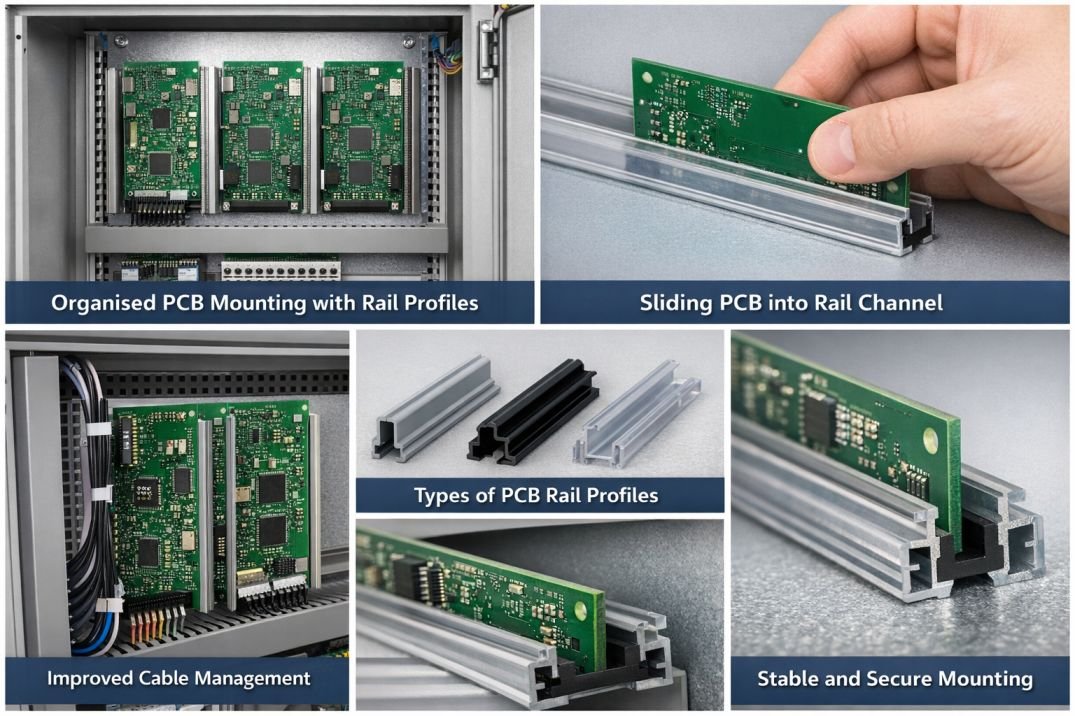
Open any electrical control panel and you will usually see the same challenge. Wires, connectors, sensors, and circuit boards all competing for limited space. When the layout is not planned carefully, the panel becomes difficult to assemble, maintain, or troubleshoot.
In many modern enclosures, engineers solve this problem by using PCB rail profiles for electrical panels. These profiles create a structured way to hold and organise circuit boards without relying on scattered screws or improvised brackets. Many panel manufacturers also rely on electric polycarbonate PCB rail profiles in India because the material provides both insulation and mechanical stability inside electrical systems.
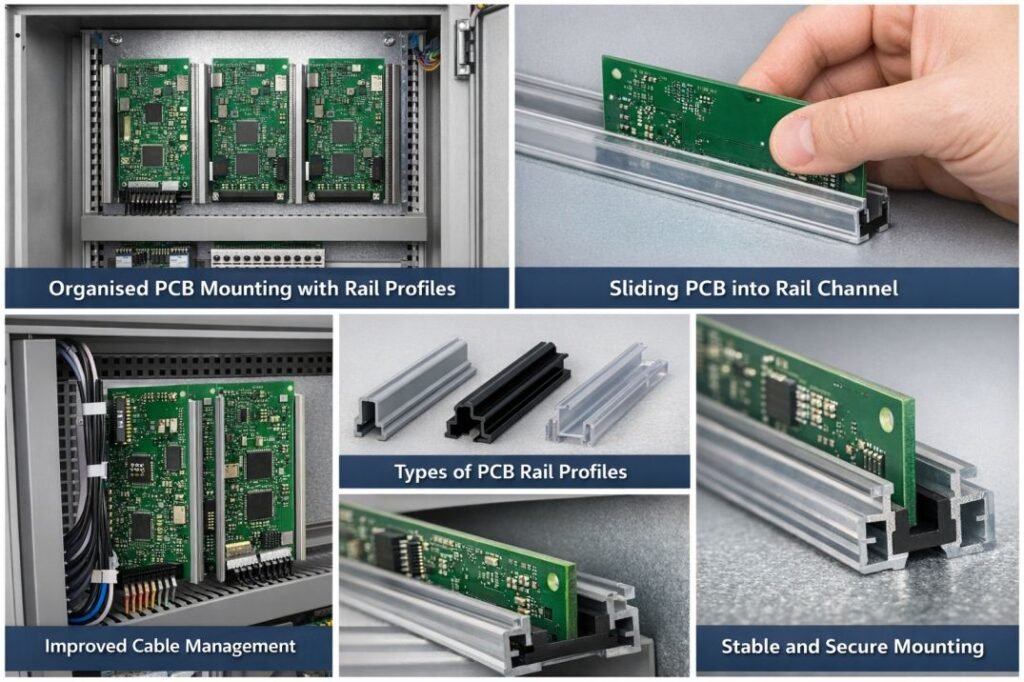
From a practical standpoint, rail-based mounting simply keeps the panel cleaner and easier to work with.
What Are PCB Rail Profiles for Electrical Panels?
PCB rail profiles for electrical panels are structural components that hold circuit boards securely inside an enclosure. Instead of mounting the PCB with individual screws, the board slides into a channel or guide created by a rail.
These rails are usually installed along the sides of the panel or integrated into the enclosure structure.
Common forms include:
- PCB mounting rail systems used in compact control panels
- Electric PCB rail profile designs used in electrical cabinets
- PCB support rails that stabilise boards during operation
- Circuit board mounting profiles used in industrial electronics
- PCB fixing rails that keep boards aligned during assembly
The idea is simple. The rail provides a controlled slot where the PCB sits securely without shifting.
Why Electrical Panels Need Better PCB Organisation
Anyone who has worked inside an electrical panel knows how quickly things become messy.
Circuit boards are often mounted using a mix of brackets, screws, and spacers. While this works initially, it can cause problems later.
Common issues include:
- Misaligned boards during installation
- Limited space for wiring
- Uneven mounting pressure on the PCB
- Difficult maintenance access
- Risk of board movement from vibration
This is why many engineers prefer PCB rail profiles for electrical panels. They bring order to the layout by creating defined positions for each circuit board.
How PCB Rail Profiles Keep Circuit Boards Organised
The biggest advantage of a PCB mounting rail is structural organisation.
Instead of mounting each board individually, the rail system provides fixed guide channels. The board simply slides into position and stays aligned.
This approach offers several practical benefits.
1. Clear Board Positioning
With PCB support rails, every circuit board has a defined location inside the panel.
This prevents overlapping components and keeps the internal layout clean.
2. Easier Panel Assembly
Assembly technicians can install boards quickly using PCB fixing rails.
The process often becomes:
- Insert the PCB into the rail channel
- Slide the board to the correct position
- Secure the enclosure
This saves time compared to screw-based mounting.
3. Better Cable Management
When boards are aligned properly, wiring paths become more predictable.
Using circuit board mounting profiles allows cables and connectors to follow organised routes, which reduces installation errors.
The Role of Material in PCB Rail Profiles
The material used for the rail also plays an important role in performance.
Many electrical enclosures use polycarbonate or similar engineering plastics because they provide a balance of strength and insulation.
An electric PCB rail profile made from polycarbonate typically offers:
- Electrical insulation
- Impact resistance
- Dimensional stability
- Heat tolerance
These properties make the rail suitable for control panels and electronic equipment where electrical safety is critical.
Comparing Traditional Mounting vs Rail-Based Systems
Mounting Method | Common Issues | Rail Profile Advantage |
Screw mounting | Uneven pressure on PCB | Even edge support |
Metal brackets | Consumes panel space | Compact structure |
Adhesive mounts | Limited durability | Long-term stability |
Custom fixtures | Slow assembly | Faster installation |
This comparison explains why PCB rail profiles for electrical panels are increasingly used in industrial electronics and control cabinets.
Practical Design Tips for PCB Rail Layout
Designing an organised panel requires more than simply adding rails.
Engineers usually consider several factors before selecting a rail system.
Important considerations include:
- PCB thickness and dimensions
- Required spacing between boards
- Connector and cable access
- Heat management inside the panel
- Vibration levels during operation
Understanding these aspects helps create a reliable rail design.
If you are planning a rail-based mounting system, it is useful to review the important factors when finalising a PCB rail profile, especially when designing panels for large production runs.
Where PCB Rail Profiles Are Commonly Used
Today, PCB rail profiles for electrical panels are widely used across multiple industries.
Typical applications include:
- Industrial control panels
- Automation equipment
- Power supply units
- Telecommunication systems
- Electrical distribution cabinets
In these systems, organised PCB mounting improves both reliability and maintenance efficiency.
Key Benefits of Using PCB Rail Profiles
A well-designed PCB mounting rail system provides several advantages.
Improved panel organisation
Rail structures create defined board positions and prevent layout clutter.
Faster assembly
Technicians can install circuit boards quickly using guide rails instead of screws.
Better mechanical stability
PCB support rails hold boards firmly and reduce vibration-related movement.
Simplified maintenance
When boards are organised properly, troubleshooting and replacement become easier.
These benefits explain why PCB rail profiles for electrical panels have become standard components in modern electrical enclosures.
Conclusion
Electrical panels are becoming more compact and complex every year. As more components are integrated into smaller enclosures, organisation inside the panel becomes critical.
From practical experience, one of the simplest ways to improve panel layout is by using PCB rail profiles for electrical panels. They provide clear board positioning, reduce installation time, and help maintain a clean internal structure.
Instead of relying on multiple brackets or mounting points, rail systems guide the circuit board into place and keep it stable during operation.
Manufacturers like M3 Extrusion produce engineered rail profiles designed to support electrical equipment manufacturers who require consistent and reliable PCB mounting solutions.
When panel organisation improves, assembly becomes easier and long-term system reliability also increases.
FAQs
What are PCB rail profiles used for in electrical panels?
PCB rail profiles are used to hold circuit boards securely inside electrical panels. They create guide channels that keep PCBs aligned and organised. This mounting method reduces movement, simplifies installation, and helps maintain a structured panel layout, which improves both reliability and maintenance access.
How do PCB mounting rails help organise circuit boards?
A PCB mounting rail provides a fixed guide where the circuit board slides into position. This eliminates the need for multiple screws and brackets. As a result, boards remain evenly aligned, wiring becomes easier to manage, and the overall electrical panel layout stays organised.
What is an electric PCB rail profile?
An electric PCB rail profile is a structural component designed to support circuit boards inside electrical enclosures. It acts as a guide channel that holds the PCB edges securely while providing insulation and stability in electronic systems.
Why are PCB support rails important in control panels?
PCB support rails stabilise circuit boards and prevent movement caused by vibration or cable tension. By holding the board along its edges, they reduce stress on solder joints and electronic components, which improves the long-term reliability of the electrical panel.
Are PCB fixing rails better than screw mounting?
In many applications, PCB fixing rails provide better support than traditional screw mounting. Rails distribute mechanical load evenly across the board edges and allow faster installation. This reduces assembly time while improving consistency in electrical panel manufacturing.
Can PCB rail profiles be customised for different panels?
Yes, PCB rail profiles can be customised based on PCB thickness, enclosure size, and mounting layout. Custom profiles help manufacturers create organised and reliable circuit board mounting systems that fit specific electrical panel designs.