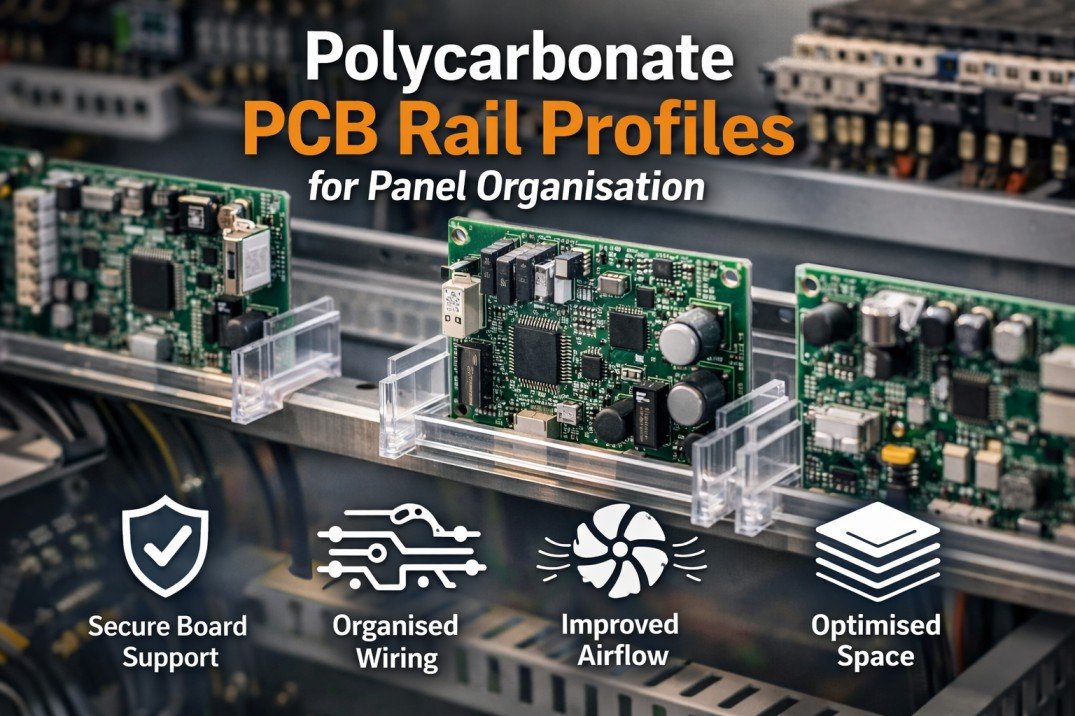
Whether you want to organise new electrical panels or make existing ones easier to maintain, using polycarbonate PCB rail profiles can be an effective solution. Not only do they keep circuit boards aligned, but they also make wiring cleaner and handling during installation or maintenance much easier. Unlike metal strips, plastic clips, or simple tape supports that can bend, break, or fail over time, electric PCB rail mounting profiles provide a secure and stable fit for every circuit board.
With polycarbonate PCB rail profiles, panels in manufacturing setups, power systems, control panels, and other electrical installations stay organised and safe. They prevent wires from tangling, reduce installation errors, and make routine maintenance faster.
What Are Polycarbonate PCB Rail Profiles?
Polycarbonate PCB rail profiles are support elements used inside electrical panels to hold printed circuit boards securely. They have grooves or channels that match the edge of a circuit board, so boards stay steady and straight.
These profiles are made from polycarbonate, a strong and stable plastic that resists heat and impact. Being non-conductive, polycarbonate adds extra safety by reducing the risk of short circuits in panels with live electrical components.
Polycarbonate profiles for electrical equipment help boards slide in and out smoothly during installation or service. This reduces handling damage and keeps wiring paths clear. Because they hold boards evenly, panels look neater and are easier to maintain.
5 Ways Polycarbonate PCB Rail Profiles Improve Electric Panel Organisation
Polycarbonate PCB rail profiles do more than simply hold circuit boards. They influence the structure of the entire panel by improving layout, safety, airflow, and handling. Below are five clear ways these profiles make panels better organised.
Strong and Safe PCB Support
Circuit boards inside electrical panels must stay steady during use and service. When circuit boards shift under vibration or movement, wiring can loosen, and connections can fail. Polycarbonate rail profiles keep circuit boards firm, aligned and protected.
- Secure Circuit Board Positioning: Polycarbonate PCB rail profiles lock circuit boards into stable slots so they do not shift during normal use. This helps maintain firm connections.
- Non‑Conductive Safety: Since polycarbonate does not conduct electricity, these profiles help prevent short circuits and protect both circuit boards as well as wiring inside the panel.
- Reduced Stress on Components: With circuit boards held straight, solder joints and connectors are not bent or stressed by uneven pressure.
- Impact Resistance: Polycarbonate absorbs small shocks without cracking, which protects circuit boards if the panel is moved or bumped.
Holding circuit boards securely reduces errors and extends the life of both the circuit boards and the panel equipment.
Better Panel Layout and Clean Lines
Panels with neat layouts are easier to build, inspect and maintain. Random circuit board placement often leads to tangled wires and unclear paths, which makes installation and maintenance more difficult.
Polycarbonate PCB rail profiles space circuit boards evenly, which makes wiring routes clean and organised.
- Clear Wiring Paths: The even spacing created by these rail profiles ensures wires do not twist around parts or block access to other areas.
- Simpler Inspection: Panels equipped with polycarbonate rail profiles allow technicians to review circuit board placement and connections visually without moving parts.
- Professional Appearance: Thanks to proper support from the profiles, circuit boards are neatly placed, and wiring stays tidy, giving panels a well-organised, professional look.
- Consistent Circuit Board Alignment: Polycarbonate PCB rail profiles keep circuit boards lined up evenly, which helps wires run neatly and reduces tangling.
By keeping circuit boards neatly in place, Polycarbonate PCB rail profiles help reduce assembly mistakes and make it easier to spot issues later.
Easy Installation and Maintenance
Installing or removing circuit boards can be tough without proper support. If circuit boards are loose, installers may force them into place or move wires out of the way. These actions can damage parts or slow down work. Polycarbonate rail profiles make circuit board handling easier and faster.
- Smooth Circuit Board Insertion: Circuit boards slide into the profiles without force, which reduces the risk of bending cables or damaging parts.
- Faster Removal: Polycarbonate PCB rail profiles allow a circuit board to be taken out quickly without moving or disturbing nearby circuit boards or wires.
- Guided Placement: Polycarbonate PCB rail profiles provide clear slots for circuit boards, helping technicians insert each one correctly the first time.
- Safe Handling: The profiles protect both circuit boards as well as wires, preventing accidental damage during installation or maintenance.
Using Polycarbonate PCB rail profiles simplifies installation, speeds up maintenance, and keeps panels safe and organised for long-term use.
Improved Airflow and Cooling
Circuit boards generate heat as they work. Heat buildup inside a panel can shorten the life of parts and increase the risk of failures. When circuit boards are crowded or uneven, air circulation is poor. Polycarbonate rail profiles help manage circuit board spacing, which promotes airflow inside the panel.
- Even Spacing Between Circuit Boards: Polycarbonate PCB rail profiles ensure circuit boards do not block each other, allowing air to flow freely between gaps.
- Enhanced Heat Dissipation: With proper spacing from the rail profiles, airflow carries heat away from components more efficiently.
- Compatibility With Fans and Vents: The spacing provided by Polycarbonate PCB rail profiles helps forced air move through the panel instead of around obstacles.
- Lower System Temperature: Panels with circuit boards organised using Polycarbonate PCB rail profiles stay cooler, which prolongs component life and stabilises performance.
With Polycarbonate PCB rail profiles, airflow inside the panel is optimised, keeping components cooler, protecting circuit boards, and improving overall system reliability.
Improved Space Utilisation
Electrical panels often have limited space, and inefficient placement of circuit boards can create crowded areas that are hard to work with. Polycarbonate PCB rail profiles help technicians and installers make the most of available space by holding circuit boards precisely and evenly. This allows panels to house more boards without clutter and keeps everything accessible.
Space Aspect | How Polycarbonate PCB Rail Profiles Help |
Optimised Board Placement | Boards fit securely in designated positions, leaving gaps for wiring and airflow. |
Compact Layout | Profiles allow multiple boards to be installed in tight spaces without interference. |
Efficient Cable Routing | Evenly spaced boards make it easier to run wires neatly along intended paths. |
Accessible Components | Proper spacing ensures that each board is reachable for maintenance or inspection. |
Future Expansion | Panels retain room for adding more boards or components when needed. |
By keeping circuit boards organised and evenly spaced, Polycarbonate PCB rail profiles improve panel space utilisation, making installations cleaner, easier to maintain, and ready for future upgrades.
How to Choose the Right Polycarbonate PCB Rail Profiles
Selecting the right polycarbonate PCB rail profiles ensures your electrical panels stay organised, safe, and easy to maintain. A well-chosen profile not only holds circuit boards securely but also simplifies installation, improves airflow, and makes future upgrades easier.
Here’s how to make the best choice for your panels.
Match the Profile to Your Circuit Board Size
Circuit boards vary in width, length, and thickness. The grooves in polycarbonate PCB rail profiles must fit the edges of each circuit board snugly without being too tight or loose. Measure your circuit boards carefully before selecting profiles.
Consider Your Panel Layout
Electrical panels can have single-row, double-row, or stepped layouts. Choose electric PCB rail mounting profiles that fit your specific layout plan. Some profiles are straight, while others can be cut to match complex arrangements, ensuring consistent support for all circuit boards.
Look for Quality and Secure Fit
Polycarbonate PCB rail profiles should hold circuit boards firmly while allowing smooth slide-in and slide-out motion. Testing sample pieces before placing bulk orders helps confirm they provide a secure fit and reliable performance across all your panels.
Consider Cost Efficiency
Polycarbonate PCB rail profiles vary in price, but the cheapest option may not be the best one. Make sure you choose profiles that offer a balance between affordability and durability. Investing in reliable profiles reduces replacements and maintenance costs, saving money over the long term.
Conclusion
Polycarbonate PCB rail profiles have become a key part of organised, reliable electrical panels. They offer strong support, better layouts, easier service, improved airflow and consistent board handling. These benefits help both builders and technicians work faster, safer, and with fewer errors.
Organised panels reduce wiring confusion, speed up fault finding, and improve quality control. They look neat and professional, which matters for both field work and inspections.
Are you looking for durable and reliable polycarbonate PCB rail profiles for your electrical panels? M3 Extrusion offers high‑quality polycarbonate PCB rail profiles that deliver secure board support, easy installation and long‑lasting performance. Explore their range of electric polycarbonate profiles to find products that fit your panel needs and keep your systems organised.
Frequently Asked Questions
Why use polycarbonate PCB rail profiles in electrical panels?
Polycarbonate PCB rail profiles hold circuit boards firmly and keep them aligned. They make wiring neater, simplify installation, and reduce the risk of board damage. Panels stay organised, safe, and easier to maintain over time.
How do polycarbonate PCB rail profiles improve panel airflow?
By keeping boards evenly spaced, rail profiles allow air to pass freely between them. This reduces heat buildup, improves cooling efficiency and helps maintain stable performance for electrical components inside the panel.
Do polycarbonate PCB rail profiles help with wiring organisation?
Yes. Rail profiles guide board placement, which creates clear pathways for wiring. This prevents tangling, simplifies installation, and makes it easier to trace and manage wires during maintenance or upgrades.
How durable are polycarbonate PCB rail profiles?
Polycarbonate PCB rail profiles are strong, impact-resistant, and heat-resistant. They maintain their shape even after repeated board insertion and removal, making them reliable for long-term use in electrical panels without cracking, warping, or losing support.