Anyone who has worked on commercial fabrication or industrial assemblies knows this moment. The drawing looks right, the material looks clear, and the sample fits. Then, months later, the profile yellows, cracks, or simply does not match the next batch. In India, demand for transparent PVC profiles has grown across lighting, refrigeration, glazing, and display systems. But many of the problems seen on site or in production come from avoidable selection mistakes.
This guide focuses on the real issues buyers face and how to prevent them, based on practical manufacturing and installation experience.
What Is a Transparent PVC Profile
A transparent PVC profile is a rigid or semi rigid extruded plastic component designed to allow light transmission while maintaining shape and dimensional stability. These profiles are commonly used where visibility, protection, and structural consistency are required.
They are not all the same. Differences in raw material grade, extrusion control, and post processing can change how a profile performs over time.
Why Problems Usually Start at the Selection Stage
Most issues do not appear on day one. They show up after installation, exposure, or repeat production.
Common causes include:
Over focusing on appearance instead of performance
Ignoring application environment
Choosing profiles without tolerance data
Selecting the wrong profile can affect clarity, fit, and service life.
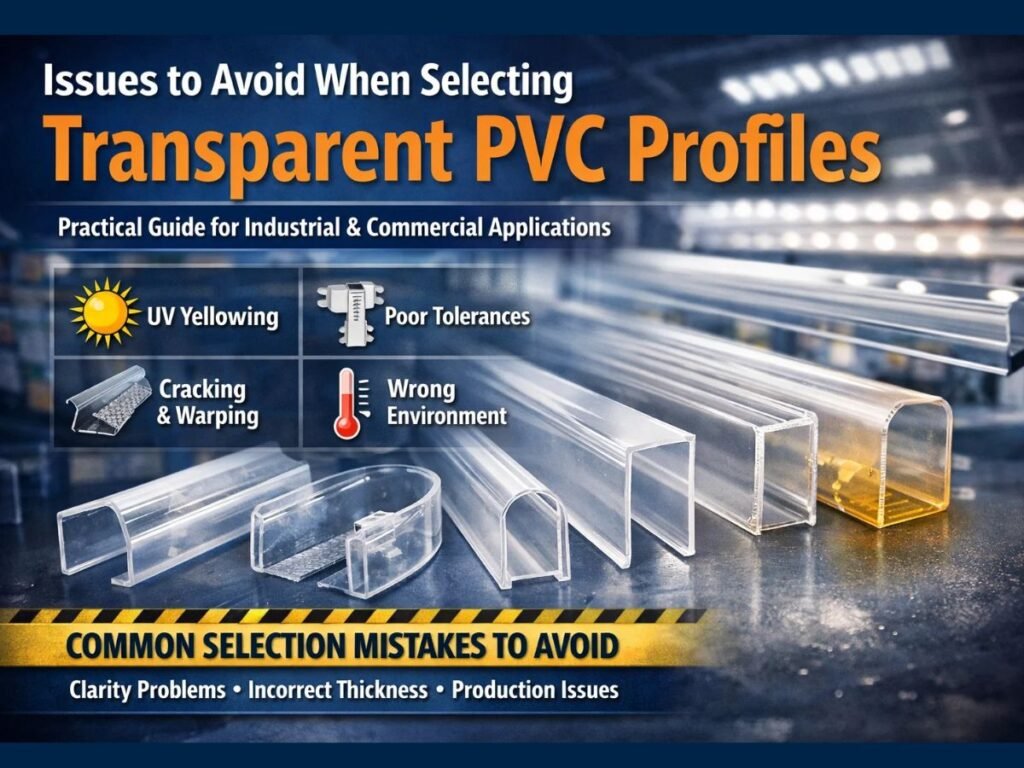
Issue 1: Ignoring Long-Term Clarity Requirements
A profile that looks clear during inspection may not stay that way.
Transparent PVC can lose clarity due to:
Poor UV resistance
Low-grade stabilisers
Inconsistent cooling during extrusion
If the application involves lighting, display panels, or visible edges, long-term clarity should be specified, not assumed.
Quick check: Ask how the profile performs after extended light exposure, not just initial transparency.
Issue 2: Choosing the Wrong Thickness for the Application
Thickness directly affects both strength and clarity.
Too thin:
Can flex or crack
May distort under heat
Too thick:
Can reduce light transmission
Adds unnecessary material cost
Always select thickness based on load, span, and exposure, not visual preference alone.
Issue 3: Overlooking Tolerance Consistency
This issue becomes serious in repeat production.
Small variations in width or wall thickness can cause:
Loose fits in aluminium channels
Assembly delays
Rejected batches
Tolerance control matters more than surface shine. Profiles used in lighting systems, cold storage doors, or glazing tracks need repeatable dimensions across every batch.
Issue 4: Not Matching the Profile to the Environment
Transparent PVC behaves differently depending on where it is used.
Common environments include:
LED lighting housings
Refrigeration units
Indoor partitions
Covered outdoor façades
Each requires different resistance levels to heat, moisture, or cleaning chemicals. Selecting a generic profile for all uses often leads to early failure.
Issue 5: Misunderstanding Surface Finish Requirements
Clarity is not only about transparency.
Surface finish affects:
Light diffusion
Glare control
Scratch visibility
Some applications need a smooth, clear finish. Others perform better with a light diffusion or matte surface. This should be decided during design, not after extrusion.
Issue 6: Selecting Based on Sample Only, Not Production Capability
A sample tells you how one piece looks. It does not guarantee repeatability.
Before finalising:
Review extrusion capability
Confirm batch consistency
Ask about quality checks
This is especially important for OEMs and project manufacturers who require the same profile over long periods.
Issue 7: Not Considering Assembly and Handling
Transparent profiles often show handling marks more clearly than opaque ones.
Poor selection can lead to:
Visible scratches during installation
Stress marks near fasteners
Edge damage during transport
Profiles should be selected with handling and assembly methods in mind, not just end use.
Enhancing Clarity Using Transparent PVC Profiles
In real projects, clarity is not just visual. It is functional.
Enhancing clarity using transparent PVC profiles means:
Maintaining consistent light output in LED systems
Avoiding colour shift over time
Ensuring uniform appearance across long runs
This depends on resin quality, extrusion temperature control, and cooling methods. Profiles designed for clarity must be produced with these factors in mind, especially when used in continuous lighting or display systems.
Practical Advice From Manufacturing Experience
From real production feedback, the best results come when selection involves both design and manufacturing input.
Key steps that help:
Define the application environment clearly
Specify tolerance limits early
Test clarity under actual lighting conditions
Confirm repeat supply capability
Manufacturers such as M3 Extrusion often work directly from drawings and technical specifications to avoid these issues before production begins.
Final Takeaways
Transparent PVC profiles play a functional role in many industrial and commercial systems. Most failures are not material defects but selection errors.
Choosing the right profile means balancing clarity, strength, consistency, and environment. When these factors are considered early, transparent profiles perform reliably over long service periods.
FAQs About Transparent PVC Profiles
What causes transparent PVC profiles to lose clarity over time
Loss of clarity is usually caused by poor UV resistance, low quality stabilisers, or incorrect extrusion temperatures. Exposure to strong light and heat accelerates the process, especially in lighting and display applications.
How do I choose the right thickness for a transparent PVC profile
Thickness should be based on load, span, and operating temperature. Thinner profiles may flex, while thicker ones can reduce light transmission. Always match thickness to the functional requirement, not appearance alone.
Are transparent PVC profiles suitable for LED lighting systems
Yes, they are commonly used in LED lighting for protection and light control. The key is selecting a profile designed for consistent clarity and heat exposure to avoid yellowing or distortion over time.
Why is tolerance control important in transparent profiles
Tolerance control ensures every profile fits the same way during assembly. Poor tolerance leads to loose fits, uneven gaps, and production delays, especially in repeat manufacturing and large projects.
Can transparent PVC profiles be customised for specific uses
Transparent PVC profiles can be produced in custom shapes and finishes based on drawings and application needs. Customisation allows better fit, improved clarity performance, and reliable integration with other materials.
What should I check before approving a transparent PVC profile
Check clarity stability, dimensional tolerances, surface finish, and production repeatability. It is also important to review how the profile performs under actual operating conditions, not just during initial inspection.
Check related articles for more insights:
- Why Manufacturers Prefer Transparent PVC Profiles for Custom Solutions
- How Transparent PVC Profiles Meet Modern Industrial Demands
- Understanding the Applications of Transparent PVC Profiles in Industrial and Commercial Use
- How Transparent PVC Profiles Are Revolutionizing the Building and Lighting Industry