Whether you want to reduce breakage in plastic components or make them last longer under regular handling, using High Impact Polystyrene (HIPS) for your parts can be an ideal solution. Plastic components often fail because they cannot absorb impact during handling, assembly, or use. HIPS addresses this issue by offering higher impact resistance than standard polystyrene.
This added toughness helps components withstand repeated stress without cracking or snapping. As a result, parts made from high-impact polystyrene plastic in the USA perform more reliably in industrial environments. Selecting the right HIPS grade further improves breakage resistance, as different grades are designed to handle varying levels of impact and load.
Not to mention the fact that pairing HIPS with simple design choices like thicker areas as well as rounded corners makes stress distribute more evenly. This reduces weak points, lowers breakage rates and helps industrial units maintain consistent performance while minimizing downtime and replacement costs.
What Is High-Impact Polystyrene?
High Impact Polystyrene, or HIPS, is a plastic made to resist breakage. It is created by blending standard polystyrene with rubber. This change improves toughness and allows the material to absorb impact instead of cracking. HIPS is stronger than regular polystyrene but still easy to mold and shape. This makes it suitable for plastic components used in industrial settings.
Parts made from cost-effective HIPS solutions handle stress from handling, assembly, and operation more effectively. Because of this balance of strength as well as workability, HIPS is widely used where plastic components need better durability without added complexity.
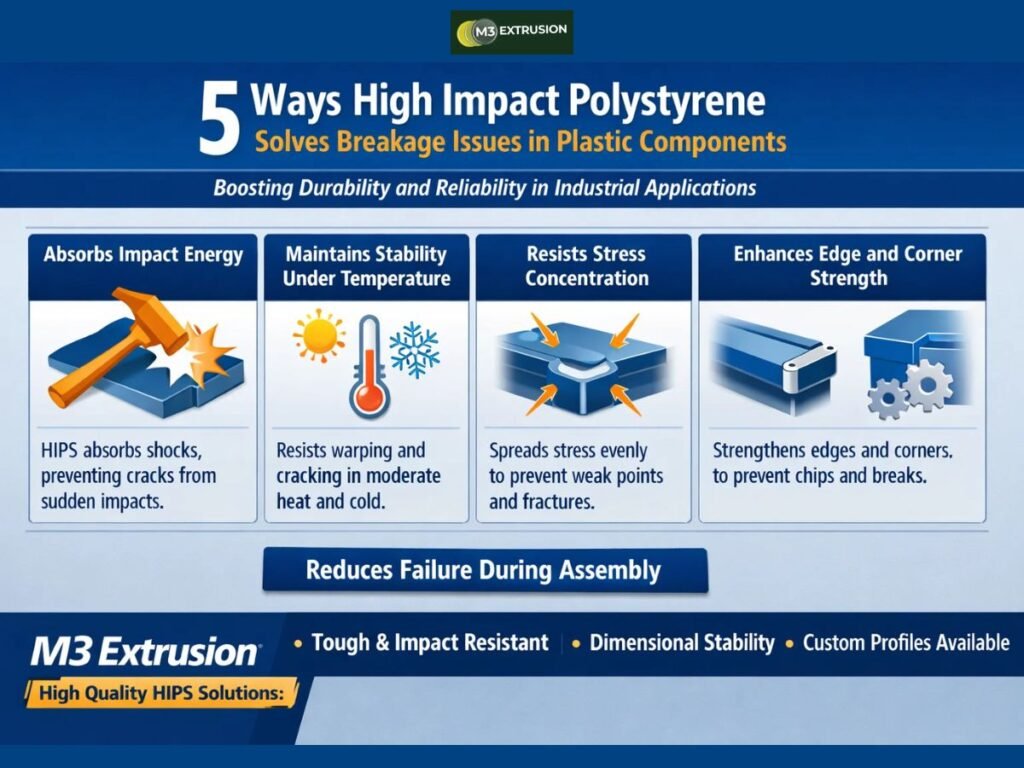
5 Ways High-Impact Polystyrene Solves Breakage Issues in Plastic Components
With its balanced strength and flexibility, high-impact polystyrene helps plastic components withstand impact and stress. Breakage often occurs when materials cannot absorb force during contact, movement or load. This leads to cracks, deformation, or sudden failure. HIPS reduces this risk by allowing energy to spread through the component instead of concentrating at one point.
It also maintains consistent performance during molding, which helps limit weak areas in finished parts. For industrial applications, this means fewer damaged components during handling and operation.
Here are five ways high-impact polystyrene helps reduce breakage in plastic components.
Absorbs Impact Energy
Since HIPS contains rubber particles that increase toughness, it absorbs force rather than cracking, helping plastic components withstand sudden impacts during handling, transport and use. Needless to say, this makes it perfect for parts that take repeated stress or accidental impacts in industrial use.
- Reduces stress points: By spreading impact across the component, HIPS prevents cracks from forming in vulnerable areas, improving overall durability.
- Protects connected parts: Components made from HIPS transfer less shock to surrounding pieces, lowering the risk of damage to assemblies or linked systems.
- Extends part life: Its ability to handle repeated impacts helps components last longer, reducing replacements as well as minimizing production downtime.
By absorbing impact energy effectively, HIPS keeps plastic components strong, reduces breakage and ensures reliable performance in industrial applications.
Maintains Stability Under Temperature Changes
In addition to absorbing impact energy, high-impact polystyrene also maintains stability under moderate heat and cold, helping plastic components resist warping, shrinking, or cracking during production and everyday use. This makes it suitable for industrial parts exposed to varying temperatures.
- Prevents deformation: HIPS keeps components dimensionally stable, ensuring they fit properly and function as intended.
- Minimizes stress cracks: It reduces the formation of cracks caused by uneven expansion or contraction during temperature fluctuations.
- Preserves assembly fit: By resisting warping as well as shrinking under temperature changes, HIPS helps components retain their shape and align properly with other parts. This reduces assembly issues and lowers the risk of operational failure in industrial applications.
High-impact polystyrene’s temperature stability ensures components continue to perform reliably throughout their service life.
Resists Stress Concentration
Since HIPS has a tougher, more flexible structure than standard polystyrene, it spreads stress evenly across plastic components, preventing weak points where cracks typically start. This property is especially useful for parts subjected to repeated loads, pressure or bending during operation.
- Reduces crack formation: Even under pressure or impact, HIPS lowers the risk of fractures in high-stress areas.
- Reduces impact on joints: By absorbing and spreading force, HIPS lowers stress on connection points, preventing failures at welds, fasteners or snaps.
- Minimizes micro-cracks: It keeps components strong and dependable, preventing small cracks from turning into serious breakages during regular use.
Distributing stress across the component lets parts handle pressure more easily and perform well in industrial settings.
Enhances Edge and Corner Strength
High-impact polystyrene strengthens edges and corners, which are common weak points in plastic components. This reduces the risk of chipping, cracking, or breaking during handling, assembly, or regular use in industrial applications.
- Prevents edge damage: By reinforcing edges, HIPS helps them withstand accidental knocks, contact with tools, or rough handling, reducing breakage during operation.
- Maintains structural integrity: HIPS strengthens edges and corners, helping plastic components keep their shape and resist cracks, chips, or failure during handling, assembly, and everyday industrial use.
- Strengthens corners: It distributes stress at corners, preventing cracks from forming in these vulnerable areas and keeping components strong and reliable.
High Impact Polystyrene’s edge and corner strength ensures components remain durable, dependable, and better equipped to handle everyday industrial stress.
Reduces Failure During Assembly
Plastic components made from high-impact polystyrene withstand pressure and stress during assembly, lowering the risk of cracks, deformation, or breakage. This improves reliability and makes parts easier to fit with other components in industrial applications.
- Prevents misalignment: HIPS keeps components’ shape consistent, ensuring they fit correctly during assembly and reducing stress on adjoining parts.
- Protects connection points: It strengthens edges, corners and joints, reducing the chance of damage to fasteners, snaps or mating surfaces.
- Maintains dimensional stability: HIPS keeps components in shape under pressure, preventing warping, misalignment and cracks during assembly.
Overall, HIPS reduces the risk of failures during assembly, ensuring components stay strong, aligned and reliable throughout production.
High-impact polystyrene offers a practical solution for reducing breakage in plastic components. HIPS’ toughness, impact resistance and dimensional stability help parts withstand stress, repeated use and temperature changes. Combined with smart design choices, HIPS improves reliability, minimizes maintenance, and extends component life.
Are you looking for high-impact polystyrene solutions that reduce breakage and improve reliability in your plastic components? M3 Extrusion offers high-quality HIPS extrusion profiles designed to maintain strength, dimensional accuracy, and performance in industrial applications.
Frequently Asked Questions
How to choose the right high-impact polystyrene grade for plastic components?
Choosing the right HIPS grade depends on how much impact the part will take, its thickness, and how it will be used. Parts that face frequent impact need tougher grades, while complex shapes need grades that mold easily.
What types of plastic components benefit most from high-impact polystyrene?
HIPS works well for components exposed to impact, repeated handling, or stress. This includes housings, covers, panels, trims and enclosures where cracking or breakage is a common issue during use or handling.
What should be checked when selecting a high-impact polystyrene supplier?
Suppliers should offer consistent material quality, clear grade data, and reliable supply. It is also important to check processing support, batch consistency, and compliance with industry standards to avoid variation in finished components.
How does high-impact polystyrene compare to standard polystyrene for durability?
HIPS offers better impact resistance and flexibility than standard polystyrene. This reduces cracking and sudden failure. It is better suited for industrial components where strength as well as durability matter more than surface finish alone.
Is high-impact polystyrene suitable for components exposed to repeated impact?
Yes, HIPS is designed to absorb impact energy rather than crack. This makes it suitable for components that face repeated contact, movement or pressure during regular operation in industrial environments.
Can high-impact polystyrene withstand exposure to heat or cold?
HIPS maintains strength across moderate temperature changes. It resists warping and cracking in environments where components may face occasional heat or cold, making it suitable for many industrial and assembly applications.
Check related articles for more insights:
- High-Impact Polystyrene Plastic and Its Role in Cost-Effective Production
- Reducing Breakage and Waste with High-Impact Polystyrene Plastic
- Is Metal Too Heavy or Costly for Your Project? High-Impact Polystyrene Plastic Offers a Lightweight, Reliable Alternative