Over the years, polycarbonate profiles have become immensely popular and are widely used in industrial, construction, automotive, and protective applications due to their strength, flexibility, and durability. Crafted from high-strength plastic, a polycarbonate profile is a pre-formed shape built for consistent performance across applications.
Not only are these profiles strong, but they also resist heat, weather, and impacts that would damage ordinary materials. Polycarbonate profiles in India can be easily cut, bent, or joined to fit different designs, allowing industries to create parts, panels, covers, and protective structures efficiently.
Their combination of versatility, durability, and ease of use makes polycarbonate profiles a trusted material across many sectors.
What is a polycarbonate profile?
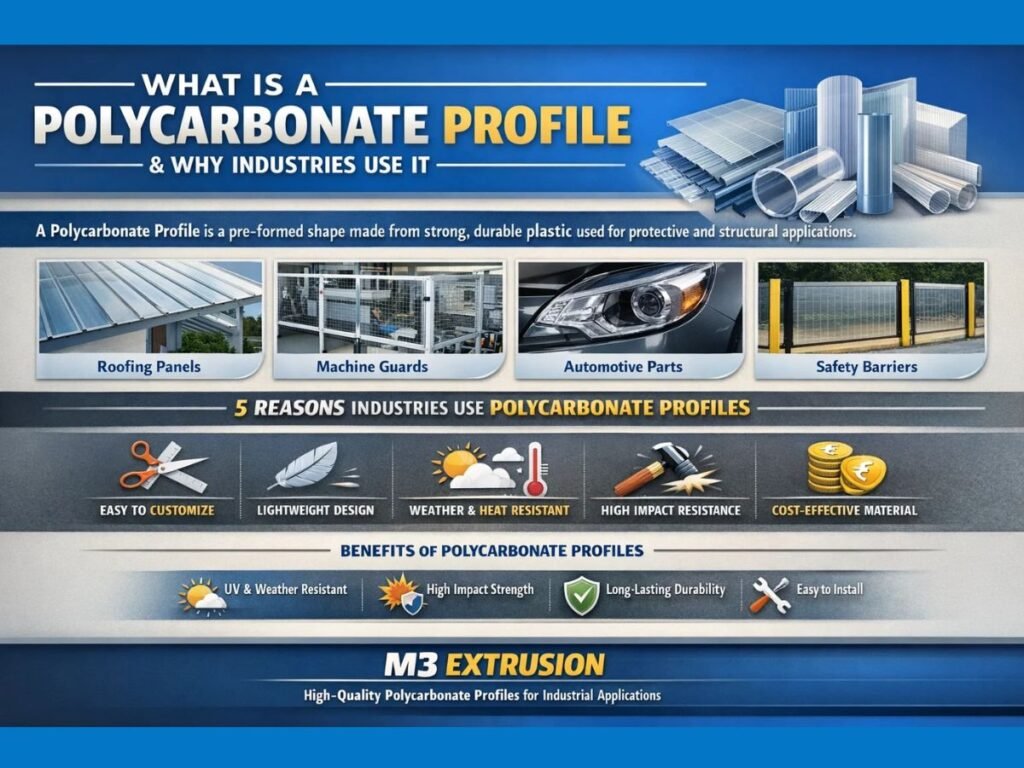
A polycarbonate profile is a pre-formed shape made from strong, durable plastic that is widely used in industries for protective and structural applications. They come in different shapes such as sheets, rods, tubes, and other custom forms, depending on how they will be used.
Industries use polycarbonate profiles in construction for roofing, windows, and safety barriers, in automotive for lamp covers and protective panels, and in manufacturing for machine guards and equipment housings.
Polycarbonate is lightweight, impact-resistant, and weatherproof, making these profiles easy to handle and long-lasting. Besides, polycarbonate profile applications are extensive. Whether used in construction, automotive, or manufacturing, these profiles can be adapted to suit different needs, providing practical solutions for a variety of industrial applications.
5 Reasons Why Industries Use Polycarbonate Profiles
As businesses look for solutions that offer high strength and can be molded into precise shapes, polycarbonate profiles have emerged as a viable option that meets diverse industrial requirements efficiently. With polycarbonate profiles, structures stay strong without adding extra weight, making handling as well as installation easier.
Industries value them for their consistent performance, adaptability, and ease of integration into different production processes.
They perform well in different industrial settings, handling a range of tasks, from protective panels to machine components, with ease. Here are five reasons why industries use polycarbonate profiles.
Easy to Customize
Since polycarbonate profiles are highly flexible, they can be easily cut, bent or formed to meet different industrial requirements. Polycarbonate retains its strength and durability even after shaping, allowing manufacturers to produce components that perform reliably in various applications.
- Supports diverse applications: Polycarbonate profiles can be customized for use in construction, automotive, manufacturing, and protective equipment, making them adaptable to a wide range of industrial needs.
- Simplifies integration: These profiles can be shaped and sized to fit seamlessly into different systems or machinery, reducing installation challenges and making assembly easier.
- Accommodates project requirements: Manufacturers can tailor polycarbonate profiles to meet specific design, size, and functional needs without compromising their performance or reliability.
By offering easy customization, polycarbonate profiles enable industries to create precise and efficient components for multiple applications.
Lightweight Design
In addition to being easy to customize, polycarbonate profiles are also lightweight, making them easier to handle, transport, and install in industrial projects without adding unnecessary stress to structures. Their low weight also allows for faster assembly and reduced labor effort.
- Reduces handling challenges: Polycarbonate profiles can be moved and positioned with minimal effort, improving efficiency on construction sites or manufacturing floors.
- Supports structural efficiency: The lightweight nature of polycarbonate profiles reduces the load on supporting frames and systems, enhancing overall design flexibility.
- Simplifies transportation: Polycarbonate profiles are easier to package and ship compared to heavier materials, lowering logistics costs and making large-scale projects more manageable.
With their lightweight design, polycarbonate profiles provide industries with versatile and efficient solutions for a wide range of applications.
Weather and Heat Resistant
Unlike glass panels or untreated metals that are prone to warping, cracking or fading under extreme temperatures and sunlight, polycarbonate profiles remain strong as well as reliable. Their resilience ensures consistent performance in both indoor and outdoor industrial applications.
- Protects against environmental damage: Polycarbonate profiles resist heavy rain, and fluctuating temperatures, keeping components intact and functional over time.
- Maintains structural integrity: These profiles do not easily deform under heat or cold, allowing them to retain their shape and strength in diverse conditions.
- Prevents color fading: Polycarbonate profiles resist discoloration from UV exposure, helping industrial products retain their appearance and professional finish.
Due to their weather and heat resistance, polycarbonate profiles provide industries with durable and dependable solutions for a wide range of projects.
High Impact Resistance
Polycarbonate profiles are exceptionally strong and resilient, allowing them to withstand heavy impacts without cracking or breaking. Their durability makes them ideal for protecting equipment, machinery as well as structural components in industrial environments.
- Absorbs shocks effectively: Polycarbonate profiles can absorb sudden impacts from external forces, reducing the risk of damage to surrounding structures and machinery.
- Protects critical components: Industries can rely on polycarbonate profiles to safeguard sensitive equipment, panels, or enclosures from accidental knocks or collisions.
- Supports long-term durability: Polycarbonate profiles maintain their strength and shape even under repeated stress, ensuring reliable performance in demanding industrial applications.
With their high impact resistance, polycarbonate profiles offer industries strong and reliable solutions for demanding industrial environments.
Cost-Effective Material
When compared to metal or glass, polycarbonate profiles offer a cost-effective solution without compromising performance. Their efficient production, low maintenance needs and long-lasting durability help industries save on overall project costs, making them practical for a wide range of applications.
- Reduces material expenses: Polycarbonate profiles cost less to produce and transport, helping companies save on raw materials and logistics.
- Lowers labor costs: Polycarbonate profiles are easier to handle and install, reducing time and effort during assembly or construction.
- Minimizes maintenance costs: Polycarbonate profiles resist corrosion, impacts, and environmental wear, lowering the need for frequent repairs or replacements.
By providing an economical and reliable option, polycarbonate profiles allow industries to reduce expenses while maintaining high performance across projects.
Conclusion
In today’s industrial landscape, polycarbonate profiles play a vital role in creating durable and reliable structures that protect equipment, support industrial processes as well as enhance operational efficiency. Their lightweight design, high impact resistance and ability to withstand heat and weather make them ideal for a variety of applications. Industries can use polycarbonate profiles to protect equipment, simplify installation and reduce maintenance needs.
From machinery components to protective panels, these profiles offer reliable performance in challenging environments.
By incorporating polycarbonate profiles, manufacturers gain long-lasting, efficient, and adaptable materials that enhance operational efficiency and ensure consistent results across projects.
Are you looking for high-quality polycarbonate profiles that combine durability, versatility and cost-effectiveness? M3 Extrusion offers a wide range of profiles crafted to meet the highest standards, ensuring reliable performance as well as long-lasting results.
Frequently Asked Questions
Can polycarbonate profiles be customized?
Yes, polycarbonate profiles can be cut, bent, and shaped to meet specific design or industrial requirements. This allows manufacturers to create custom parts, panels, and covers for various applications while maintaining durability and performance.
Are polycarbonate profiles suitable for outdoor use?
Yes, polycarbonate profiles are weatherproof, UV-resistant, and able to withstand temperature changes, making them suitable for outdoor applications such as roofing, skylights, protective barriers, and other structural components exposed to environmental conditions.
How long do polycarbonate profiles last?
Polycarbonate profiles are long-lasting due to their durability and resistance to impact, heat, and weather. With proper installation and minimal maintenance, they can serve in industrial, automotive, and construction applications for many years without losing strength or performance.
Can polycarbonate profiles withstand high impact?
Yes, polycarbonate profiles are highly impact-resistant. They can absorb shocks and resist cracking or breaking, making them suitable for protective panels, machine guards, automotive parts, and other industrial applications where durability under force is essential.
Are polycarbonate profiles easy to install?
Polycarbonate profiles in India are lightweight and can be cut, bent, or joined easily, making installation straightforward. Their adaptability allows them to fit different designs, reducing labor effort and installation time in construction, manufacturing, or automotive projects.
Check related articles for more insights:
- Understanding Polycarbonate Profiles and Their Applications in Modern Projects
- Why Businesses Choose Polycarbonate Profiles for Long-Term Durability
- How to Protect Electrical Components from Impact and Wear with Polycarbonate Profiles
- Why Choosing the Right Manufacturer Matters for Reliable Electric Polycarbonate Profiles