Widely renowned for their strength and long service life, HDPE profiles have become a common choice for strong support parts in machines, conveyors, and industrial equipment.
Made from high-density polyethene, these profiles offer a strong balance of rigidity and flexibility. This makes them suitable for parts that face regular movement, load, and contact during use.
Not only do they provide steady support, but they also help improve safety in different setups. Custom HDPE profiles for industrial use are easy to cut, shape, and install, which helps reduce effort during assembly and setup work.
However, while many suppliers offer HDPE profiles, the quality can vary widely from one supplier to another. Small issues in extrusion can affect shape, surface finish, strength and long-term performance. These defects are often not visible at first but can create problems after installation or regular use.
Knowing the warning signs of poor HDPE profile quality helps you avoid weak products and choose profiles that perform well over time.
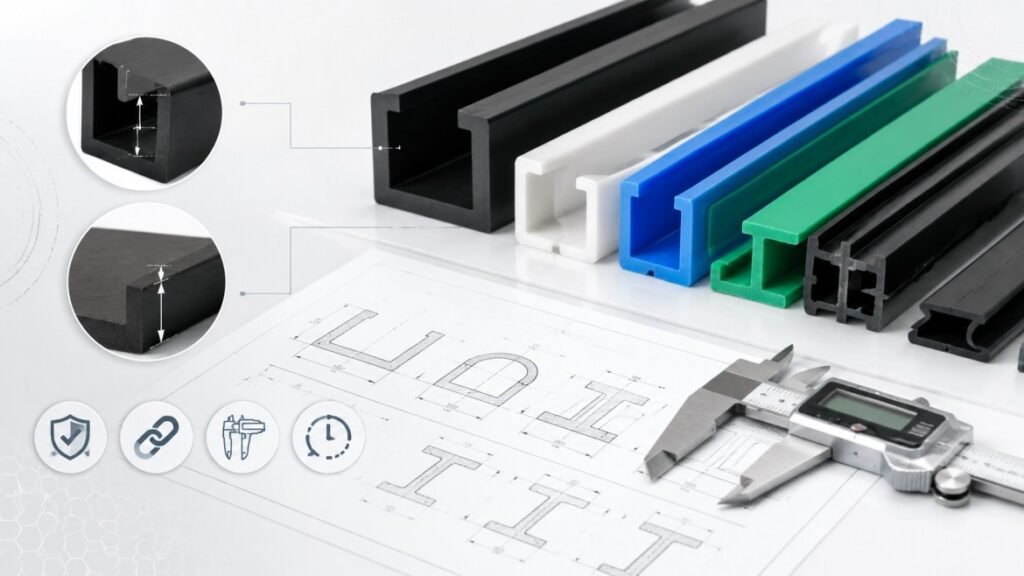
Common Warning Signs of Poor Quality HDPE Profiles
Poor HDPE profiles often show clear signs if you look closely. These signs can be seen in surface finish, shape, strength, and structure. Each issue affects performance in real use.
Below are five common warning signs to watch for during inspection or purchase.
Rough or Uneven Surface Finish
One of the most common signs of poor-quality HDPE profiles is a rough or uneven surface finish. A high-quality HDPE profile should always have a smooth and even surface. The finish should look clean from one end to the other. If the surface feels rough or looks uneven, it is a clear warning sign of poor production control or low-grade material.
In many cases, these surface issues start during the extrusion process. Unstable moulding or wrong temperature control can disturb the flow of material. Poor mixing of raw material can also create marks and uneven spots on the surface. All of this affects both the look and the performance of the profile.
Common surface problems include:
- Dull finish instead of a smooth look
- Uneven shine across different sections
- Small marks or lines visible under light
A rough surface also creates practical issues. Dust as well as dirt can stick more easily, making cleaning harder. It can also affect how the profile fits into other parts of a system. In long-term use, uneven surfaces may wear out faster compared to smooth profiles.
High-quality HDPE profiles should always maintain a consistent finish, even after cutting or shaping. Any sign of roughness during inspection should not be ignored.
Warping or Shape Distortion
No matter how strong HDPE profiles may look, if they are warped or deformed, they may not work as intended. HDPE profiles must keep their shape stable. Straight lines, uniform curves, and proper alignment are important for correct fitting. If a profile bends, twists, or loses shape, it is a strong sign of poor quality. In many applications of HDPE profiles in industrial projects, even small shape changes can affect how parts fit and perform.
Warping often starts during the cooling stage of production. If the profile cools too fast or too slow, stress builds up inside the material. This stress later causes the shape to change after extrusion. This is why buyers should also check how cooling control as well as storage are managed, as poor handling can lead to warped profiles.
Shape distortion can show up in different ways:
- Bending along the length of the profile
- Twisting at one or more points
- Uneven curves instead of straight lines
- Ends that do not align properly
Warped profiles create fitting problems during installation. They may not sit properly in channels or frames. This leads to gaps, stress points, and weak support.
Over time, distorted HDPE profiles can weaken the parts they are used in. This can lead to poor alignment during fitting and affect how the machine or equipment performs. Even small bends can create serious problems in precision-based applications.
Inconsistent Thickness
Uneven thickness in HDPE profiles can not only reduce the strength of the profile but also affect how well the profile fits with other parts. HDPE profiles must have uniform thickness across the full length. Every section should have the same measurement. If the thickness changes from one side to another, it shows poor control during extrusion.
Inconsistent thickness usually happens when the flow of material is not stable during production. Poor calibration or worn-out tooling can also cause this issue. These problems create weak as well as uneven sections in the profile.
Signs of uneven thickness include:
- One side is thicker than the other
- Uneven edges or surfaces
- Variation in weight or feel
- Thin spots along the length
Inconsistent thickness reduces the strength of the HDPE profile. Thin areas turn into weak spots that can bend or fail under pressure. It also affects fit, since uneven sections do not align properly with other parts.
In industrial use, even small variations in thickness can lead to system failure or poor performance. This is why it is essential to check the thickness of HDPE profiles before purchasing them.
High-quality HDPE profiles always maintain uniform thickness across the full product length.
Poor Edge Quality or Burrs
Edges of HDPE profiles play a vital role in how well they perform during use and installation. They should be smooth, clean, and safe to handle. If edges are rough, sharp or uneven, it is a clear sign of poor finishing.
Poor edge quality usually results from dull cutting tools or poor finishing after extrusion. In some cases, the profile is not trimmed properly, which leaves extra material or burrs on the sides.
Common edge problems include:
- Sharp corners that can cause injury
- Rough edges that feel uneven
- Burrs or extra material along the sides
- Cracked edges during handling
These edge issues impact both safety and performance. Sharp edges can make installation harder as well as unsafe. There is also a risk of cuts or scratches during use. Rough edges may damage nearby parts during fitting and assembly.
Over time, poor edges may chip or crack under pressure. This reduces the life of the profile and affects system stability.
High-quality HDPE profiles should always have smooth, clean edges that are easy to handle and install.
Weak or Brittle Structure
Another major sign of poor-quality HDPE profiles is a weak or brittle structure. HDPE is known for its strength and flexibility. A good profile should feel solid but not too stiff. It should handle pressure without cracking or breaking.
If the HDPE profile feels brittle or breaks easily, it will not be able to handle normal pressure during use or installation. Weak structure is often caused by poor quality raw material or improper control during extrusion. When the material mix is not balanced, the profile does not gain proper strength. Uneven temperature during production can also form weak spots inside the HDPE profile.
Common signs of weak structure include:
- Breaking at corners during handling
- A stiff or glass-like feel instead of flexibility
These defects are not always easy to spot at the start. A profile may appear fine but can fail when it is installed or put to use. This is why checking samples before full use is important.
Weak HDPE profiles cannot handle load or pressure properly. They may fail during transport, installation, or daily use. In some cases, even normal bending can cause damage.
Strong HDPE profiles should offer a balance of flexibility and strength. Any sign of brittleness is a clear reason to reject the material.
Key Points to Check Before Selecting an HDPE Profile Supplier
Choosing the right supplier is as important as checking the HDPE profiles themselves. A reliable supplier ensures proper production control, better raw material use and consistent quality.
Reputable suppliers follow strict checks during production and maintain stable output. This reduces defects and improves long-term performance.
The table below shows important factors to review before placing an order.
Key Factor | What to Check |
Production Setup | Stable extrusion machines and controlled production process |
Sample Quality | Smooth surface, correct shape, and uniform thickness |
Custom Ability | Ability to produce required sizes and profiles |
Dimensional Accuracy | Consistent measurements across batches and orders |
Packaging Standard | Safe packing to avoid scratches and damage during transport |
Frequently Asked Questions
What are HDPE profiles used for?
HDPE profiles are used in industrial systems for support, protection, guiding parts, and structural fittings.
What causes HDPE profiles to warp?
Warping usually happens due to uneven cooling during production or poor handling after extrusion.
How can HDPE profile quality be checked?
Quality can be checked by reviewing surface finish, shape stability, thickness uniformity, and strength during handling.
Are HDPE profiles strong enough for heavy use?
HDPE profiles are suitable for heavy use when they are made with good raw material and proper production control.
Conclusion
Ignoring the warning signs of poor quality HDPE profiles can lead to rough surfaces, shape distortion, weak structure, uneven thickness, and poor edge finishing. These issues reduce both performance and safety during use.
Early inspection helps avoid product failure and reduces long-term problems in systems and installations. Choosing the right profile ensures better strength, stability, and longer service life.
Are you looking for high-quality HDPE profiles? M3 Extrusion offers durable HDPE profiles designed for strong performance and long service life across industrial applications.