Walk into any construction site or manufacturing facility and you will see a common challenge. Materials are constantly exposed to moisture, temperature changes, chemicals, and daily wear. Over time, these conditions cause many components to crack, corrode, or lose their shape.
This is where rigid PVC profile solutions in India have become increasingly useful. Many builders and manufacturers now rely on industrial PVC profiles to replace metal or wood components that struggle in demanding environments. With the help of rigid PVC extrusion, these profiles can be produced in precise shapes that handle moisture, chemicals, and structural stress more reliably.

From window systems and façade elements to cable management and equipment panels, rigid PVC profiles are now widely used because they solve practical problems faced in real projects.
What Are Rigid PVC Profiles?
Rigid PVC profiles are structural plastic components produced through rigid PVC extrusion, a manufacturing process where heated PVC material is pushed through a custom die to create a continuous shape.
These profiles can be designed in many forms, such as:
- window and door profiles
- electrical trunking channels
- structural framing components
- industrial panel edges
- protective covers and housings
Because extrusion produces consistent shapes, manufacturers can create profiles that fit perfectly within larger systems.
In simple terms, rigid PVC profiles solutions help replace materials that are heavy, prone to corrosion, or difficult to maintain.
Why Construction and Industry Are Using Rigid PVC Profiles
Traditional materials like steel, aluminium, or wood still have their place. However, many projects face recurring issues such as corrosion, frequent maintenance, or installation complexity.
Rigid PVC profiles address these concerns with practical advantages:
- corrosion resistance
- lightweight handling
- stable shape over time
- low maintenance requirements
These features explain why industrial PVC profiles are now widely used in infrastructure, building systems, and equipment manufacturing.
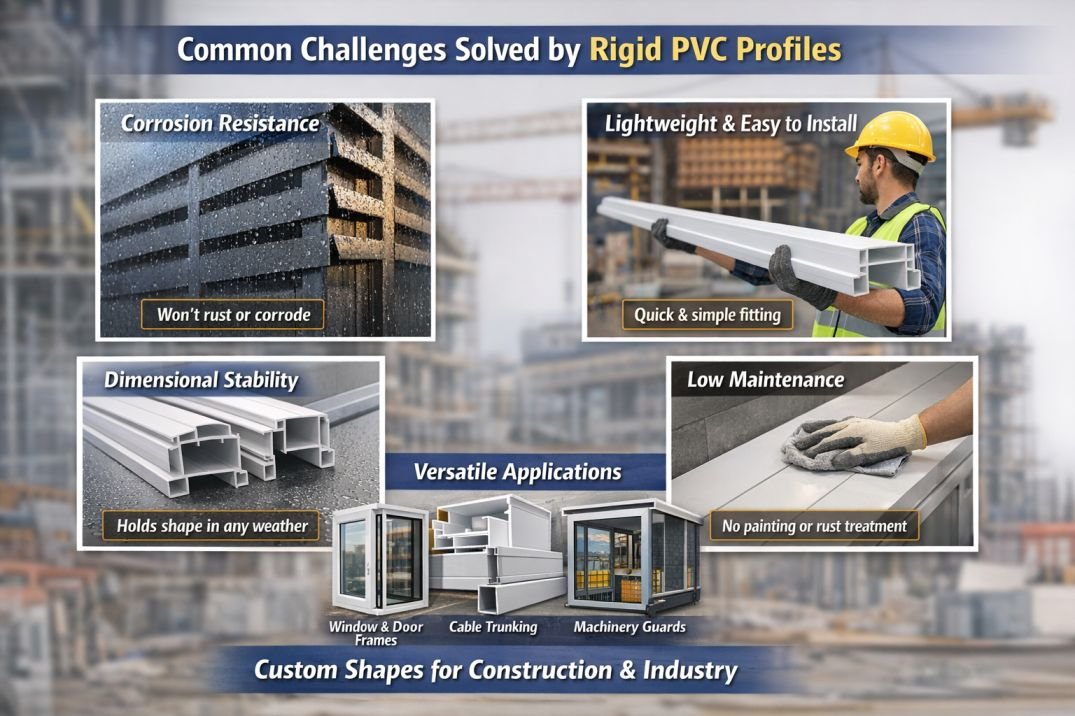
Common Challenges Solved by Rigid PVC Profiles
Below are some of the most common problems faced in construction and industrial environments and how rigid PVC profiles help solve them.
1. Corrosion and Moisture Damage
One of the biggest challenges in construction is corrosion. Metal components exposed to humidity, chemicals, or coastal environments can deteriorate quickly.
Rigid PVC profiles naturally resist moisture and most chemicals, making them suitable for environments where rust or corrosion is a concern.
Example situations
- façade systems exposed to rain
- refrigeration equipment exposed to moisture
- electrical trunking in humid environments
In these cases, rigid PVC profile solutions provide long-term durability without additional protective coatings.
2. Weight and Installation Difficulty
Heavy materials increase installation time and labour costs. Metal components often require specialised tools or equipment to install.
Rigid PVC profiles offer a lighter alternative.
Benefits include:
- easier transportation
- faster installation
- reduced structural load
Because rigid PVC extrusion allows complex shapes to be produced in one piece, installers often need fewer fasteners or connectors.
3. Dimensional Instability
Some materials expand, warp, or shrink under temperature changes. This creates alignment issues in window frames, panel joints, or structural systems.
Rigid PVC profiles maintain stable dimensions when designed correctly.
Why this matters
Stable profiles help ensure:
- accurate fitting during installation
- consistent spacing in window systems
- reliable structural alignment in equipment frames
This stability is one reason many engineers consider PVC when selecting rigid PVC profiles for projects that require precise component fitting.
4. Frequent Maintenance Requirements
Maintenance costs can quickly add up in commercial and industrial environments. Components exposed to moisture, chemicals, or heavy use may require repainting, replacement, or repair.
Rigid PVC profiles help reduce these maintenance demands.
Advantages include:
- no rust treatment required
- easy cleaning surfaces
- resistance to many industrial chemicals
In many facilities, replacing metal components with industrial PVC profiles has helped reduce long-term maintenance efforts.
5. Limited Design Flexibility
Many construction systems require customised shapes. Standard metal components sometimes limit design possibilities.
Rigid PVC extrusion solves this problem by allowing manufacturers to create custom cross-sectional shapes.
Below is a simple comparison.
Feature | Metal Components | Rigid PVC Profiles |
Shape flexibility | Limited without extra machining | Easily customised through extrusion |
Corrosion resistance | Requires coating | Naturally resistant |
Weight | Heavy | Lightweight |
Maintenance | Higher over time | Lower maintenance |
This design flexibility makes rigid PVC profiles useful solutions in both construction and industrial equipment design.
Real-World Applications of Industrial PVC Profiles
Rigid PVC profiles are now used across many sectors.
Common applications include:
Construction Industry
- window and door frames
- façade panel supports
- wall cladding components
- cable trunking systems
Industrial Equipment
- machinery guards
- control panel housings
- equipment structural frames
- conveyor system guides
Because these profiles can be customised during rigid PVC extrusion, manufacturers can produce shapes that match exact engineering requirements.
Practical Advice When Choosing Rigid PVC Profiles
When evaluating rigid PVC profiles for a project, a few factors should be considered.
1. Application Environment
Check whether the profile will be exposed to:
- sunlight
- chemicals
- heavy loads
- temperature fluctuations
Material formulations can be adjusted depending on these conditions.
2. Profile Design
The shape and wall thickness affect strength and durability.
Engineers often review:
- load-bearing requirements
- installation method
- connection points
3. Production Consistency
Profiles used in manufacturing systems must maintain consistent dimensions.
Reliable rigid PVC extrusion processes help ensure repeatable quality across production batches.
Companies such as M3 Extrusion manufacture custom PVC profiles designed for industrial applications where consistent shape, durability, and long-term performance are important.
Quick Takeaway
Rigid PVC profiles help solve several practical challenges in construction and industry.
They provide:
- corrosion resistance in demanding environments
- lighter components that simplify installation
- stable dimensions for precise fitting
- reduced maintenance requirements
- flexible design possibilities through extrusion
Because of these benefits, industrial PVC profiles continue to replace traditional materials in many modern construction and equipment systems.
FAQs
What are rigid PVC profiles used for?
Rigid PVC profiles are used in construction and industrial systems such as window frames, cable trunking, façade components, and equipment housings. They provide structural support while resisting moisture, corrosion, and chemical exposure, making them suitable for demanding environments where traditional materials may deteriorate faster.
Why are rigid PVC profiles preferred in industrial environments?
Rigid PVC profiles are preferred because they resist corrosion, moisture, and many chemicals. They also require less maintenance compared to metal components. Their lightweight structure makes installation easier while still providing durable performance in equipment systems and construction structures.
How does rigid PVC extrusion work?
Rigid PVC extrusion is a manufacturing process where heated PVC material is pushed through a shaped die to create continuous profiles. These profiles are then cooled and cut to required lengths. This method allows manufacturers to produce precise shapes with consistent dimensions for industrial and construction applications.
Are rigid PVC profiles strong enough for construction applications?
Yes, rigid PVC profiles can be designed with appropriate wall thickness and structural reinforcement to handle many construction uses. They are commonly used in window systems, façade components, and structural panels where durability, dimensional stability, and weather resistance are required.
Do rigid PVC profiles require maintenance?
Rigid PVC profiles generally require minimal maintenance. They do not rust, and their surfaces are easy to clean. In most applications, occasional inspection and cleaning are sufficient to maintain performance, which helps reduce long-term maintenance costs.
Can rigid PVC profiles be customised for specific projects?
Yes, rigid PVC profiles can be customised through the extrusion process. Manufacturers create specific dies that produce profiles in precise shapes and sizes. This allows engineers to design profiles that fit exact structural requirements for construction systems or industrial equipment.