If you have ever worked on a commercial product or an industrial assembly, you already know this problem: off-the-shelf plastic parts rarely fit exactly the way you need them to. Dimensions are slightly off, material behaviour is not consistent, or the profile simply does not support long-term use. This is where custom extruded plastic profiles come into play.
In this article, I will walk you through how custom extruded plastic in India is actually manufactured, step by step, based on how real extrusion lines operate. This is not theory. It is the practical process used every day to produce consistent profiles for refrigeration systems, windows, façades, LED lighting, and other industrial applications.
What Is Custom Extruded Plastic?
Custom extruded plastic refers to plastic profiles manufactured in a continuous shape based on a specific drawing or technical requirement. Instead of choosing a standard size, the profile is designed to match a product exactly.
From a plastic extrusion solutions point of view, extrusion allows manufacturers to control:
- Shape and cross-section
- Wall thickness
- Material properties
- Length and cutting tolerance
This makes extrusion ideal for components that must fit precisely and perform reliably over long production runs.
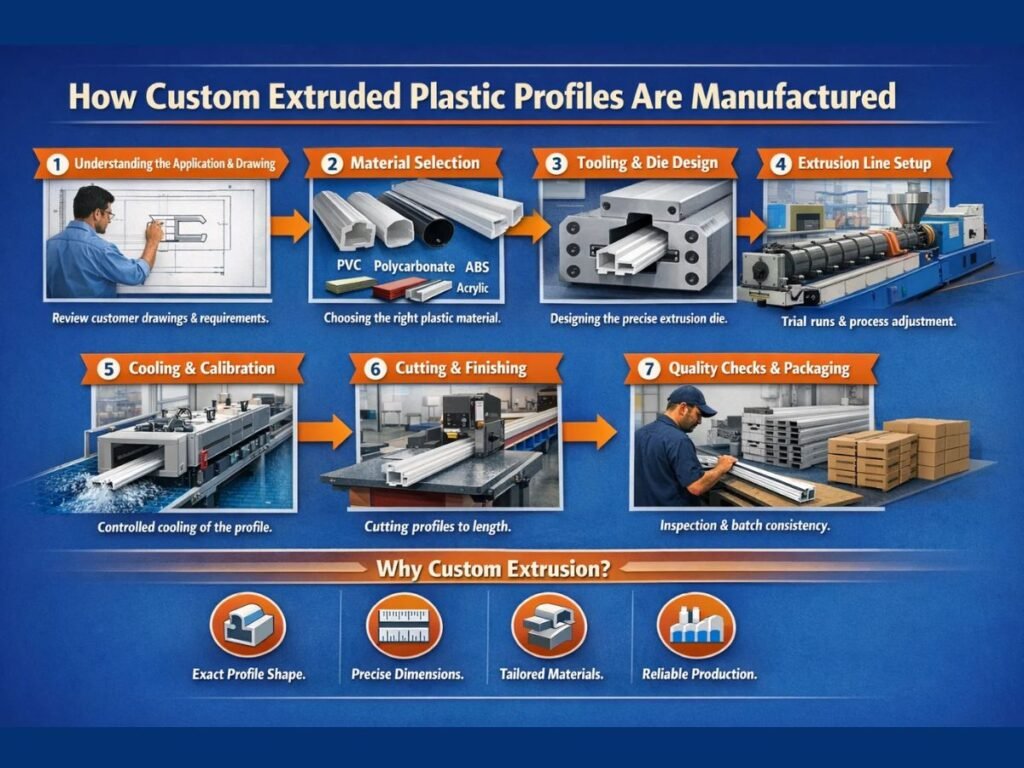
Step 1: Understanding the Application and Drawing
Every extrusion project starts with one key input: the customer’s drawing or functional requirement.
At this stage, manufacturers review:
- Cross-section design
- Dimensional tolerances
- Load or support function
- Environmental conditions such as heat, moisture, or UV exposure
For custom extruded plastic in India, this step is especially important because many profiles are designed for export or for demanding commercial use where consistency matters.
A good drawing saves time later. A vague drawing usually leads to multiple corrections.
Step 2: Material Selection Based on Use
Material choice directly affects performance. This is not a decision made only on cost.
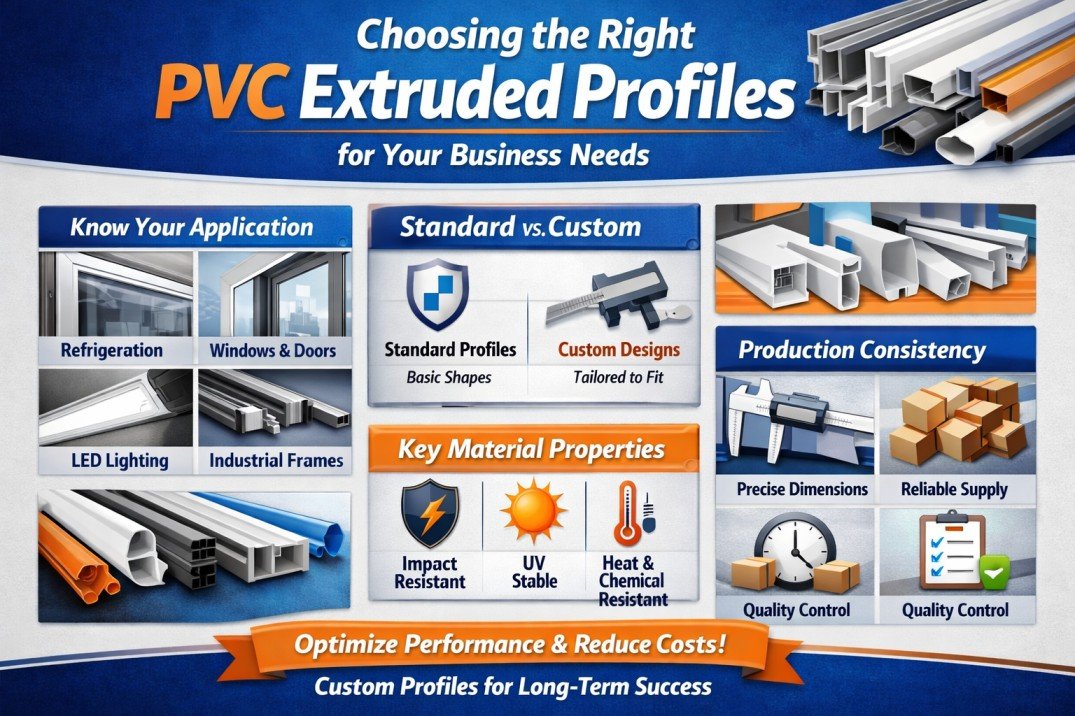
Common materials used in custom plastic extrusion include:
- PVC for rigidity, insulation, and cost control
- Polycarbonate for impact resistance and transparency
- ABS for structural stability
- Acrylic for optical clarity
The right plastic extrusion solution balances performance, durability, and ease of processing. In many projects, small material changes can significantly affect extrusion stability.
Step 3: Tooling and Die Design
Once the profile and material are finalised, the extrusion die is designed. This is one of the most critical steps.
The die controls:
- Final profile shape
- Material flow
- Surface finish
- Dimensional accuracy
In real production, dies are often fine-tuned after initial trials. This adjustment phase is normal and necessary, especially for complex profiles.
Step 4: Extrusion Line Setup and Trial Runs
After the die is ready, it is installed on the extrusion line. Trial runs are conducted to stabilise the process.
During trials, operators check:
- Melt flow behaviour
- Profile dimensions
- Cooling performance
- Surface consistency
This is where experience matters. Skilled operators can identify issues early and adjust speed, temperature, or cooling to avoid future problems.
Step 5: Cooling and Calibration
As the profile exits the die, it is still hot and flexible. Cooling must be controlled carefully.
Most custom extruded plastic in India is cooled using:
- Vacuum calibration systems
- Water cooling tanks
- Air-assisted cooling where required
Calibration ensures the profile holds its shape and dimensions consistently. Poor cooling leads to warping, shrinkage, or internal stress.
Step 6: Cutting and Finishing
Once cooled, the profile is cut to the required length. Depending on the application, profiles may be:
- Cut to fixed lengths
- Supplied in long continuous runs
- Packed for further fabrication
Finishing checks include:
- Visual inspection
- Dimensional measurement
- Surface quality review
These steps are part of standard plastic extrusion solutions for industrial use.
Step 7: Quality Checks and Batch Consistency
For industrial buyers, one good sample is not enough. Profiles must remain consistent across thousands of metres.
Quality checks focus on:
- Dimensional stability
- Material uniformity
- Fit within the final assembly
Manufacturers like M3 Extrusion work with repeat production schedules, which means maintaining the same settings and material behaviour across multiple batches.
This consistency is often more important than speed.
Real-World Example: Why Custom Extrusion Matters
In one commercial refrigeration project, a standard plastic spacer caused sealing issues after a few months. Switching to a custom extruded profile solved the problem because:
- The cross-section matched the door frame precisely
- The material handled temperature cycling better
- Installation time was reduced
This is a typical example of why companies choose custom extruded plastic in India rather than adapting standard parts.
Common Challenges in Custom Plastic Extrusion
Even with experience, extrusion has its challenges:
- Profile sag during cooling
- Material variation between batches
- Tight tolerance requirements
The solution is not one adjustment, but process control across tooling, material, and machine setup. This is why long-term suppliers matter.
Key Takeaways for Buyers and Engineers
- Custom extrusion starts with a clear drawing and application intent
- Material choice affects performance more than most people expect
- Tooling quality determines dimensional stability
- Process control ensures repeatability across batches
- Reliable plastic extrusion solutions support long-term production
Understanding the manufacturing process helps buyers make better technical decisions.
Frequently Asked Questions
What is custom extruded plastic used for?
Custom extruded plastic is used in applications where standard profiles do not fit functional or dimensional requirements. Common uses include window systems, refrigeration doors, LED lighting profiles, façade components, and industrial assemblies that require consistent shape and long-term performance.
How is custom extruded plastic different from moulded plastic?
Extruded plastic is produced as a continuous profile with a constant cross-section, while moulded plastic is formed in fixed shapes using moulds. Extrusion is better suited for long components, tight tolerances, and repeat production, whereas moulding is used for complex three-dimensional parts.
Why is PVC commonly used in custom extrusion?
PVC is widely used because it offers good strength, chemical resistance, and thermal stability at a controlled cost. It also processes well on extrusion lines and maintains dimensional consistency, making it suitable for many commercial and industrial applications.
How long does it take to develop a custom extrusion profile?
The timeline depends on profile complexity. Simple profiles may be developed within a few weeks, while complex designs requiring multiple trials can take longer. Tooling design, trial runs, and approval samples all affect the development period.
What affects consistency in custom extruded plastic?
Consistency depends on material quality, die design, machine settings, and operator experience. Stable process control and documented production parameters help ensure the same profile dimensions across repeat batches.
Can custom extruded plastic profiles be supplied in bulk?
Yes. Extrusion is well suited for bulk and repeat production. Once the process is stabilised, large quantities can be produced with consistent quality, which is why extrusion is preferred for ongoing industrial requirements.
Check related articles for more insights:
- How Custom Extruded Plastic Supports Durable and Long-Lasting Products
- 7 Benefits of Custom Extruded Plastic for Complex Design Projects in the USA
- Reducing Waste and Cost Overruns with Custom Extruded Plastic in the USA
- 5 Cost Benefits of Using Custom Extruded Plastic in Bulk Orders