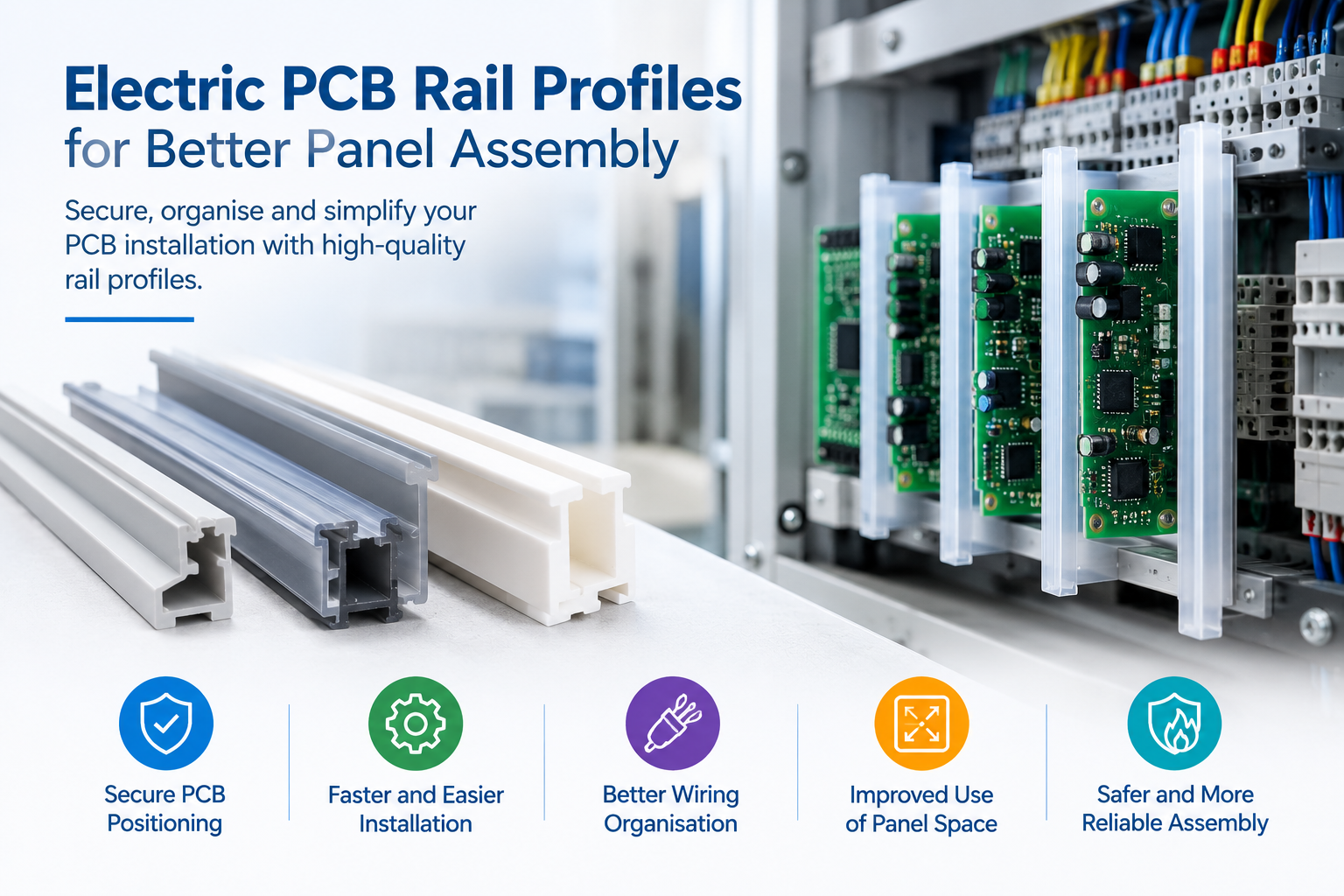
Whether you are assembling new electrical panels or upgrading existing ones, keeping circuit boards secure and aligned is vital. Loose boards can make wiring harder, slow down assembly, and put stress on parts. Electric PCB rail profiles provide a simple way to hold printed circuit boards in place while keeping the panel neat and easy to work on.
Not only do they keep PCBs firmly positioned, but they also make installation, wiring, and maintenance easier. With the rise in popularity of organised electrical panel designs, you can find a plethora of manufacturers selling custom PCB rail profiles in India.
By using electric PCB rail profiles, manufacturers can create cleaner panel layouts, simplify PCB installation, and keep circuit boards properly aligned during assembly and use.
What Are Electric PCB Rail Profiles?
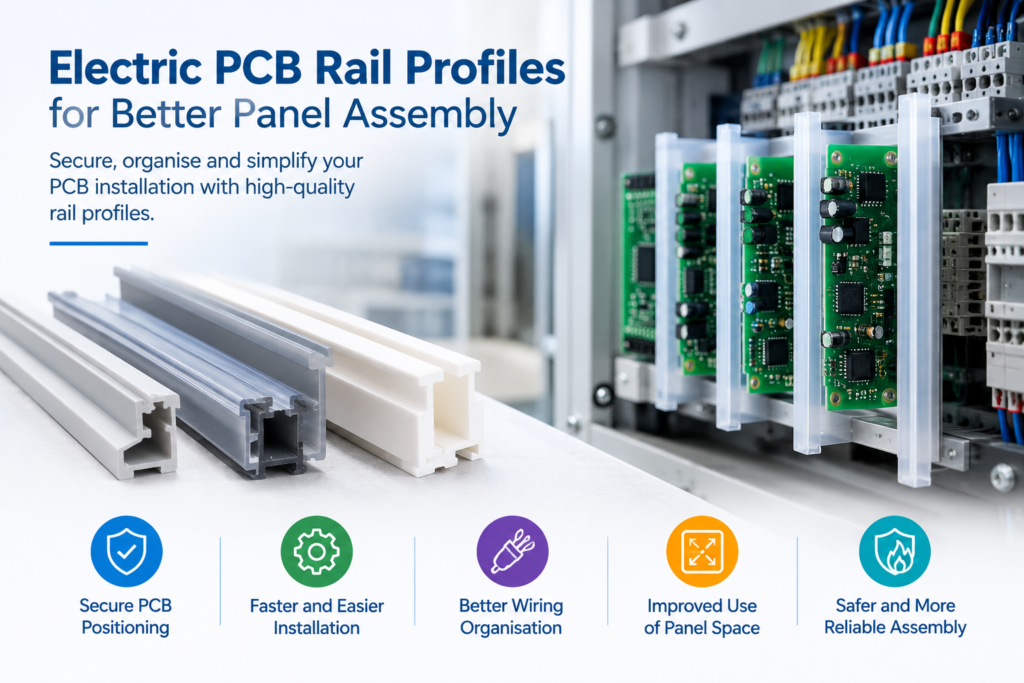
Electric PCB rail profiles are plastic extrusion parts used to hold printed circuit boards inside electrical panels and electronic enclosures. The rail design guides the PCB into position and keeps it aligned during use.
Polycarbonate profiles provide both mechanical support and electrical insulation. Their shape can also be made to match the size and design of a particular circuit board or panel. When choosing these profiles, PCB rail profile quality and specifications should be considered to ensure the rail fits the board correctly and provides the required support.
The profiles allow PCBs to slide into position while keeping a set gap between boards and other parts. This makes assembly more organised and can also make later inspection and maintenance easier.
5 Ways Electric PCB Rail Profiles Improve Electrical Panel Assembly
A well-organised electrical panel depends on more than the right components. Circuit boards also need proper support and spacing to keep the layout clean and easy to manage. Electric PCB rail profiles help create this structure while supporting the safe placement of PCBs.
Here are five ways electric PCB rail profiles can improve electrical panel assembly.
Secure PCB Positioning
A circuit board needs firm support inside an electrical panel. Movement during assembly or operation can place stress on connectors, wires, and other parts. A PCB rail profile keeps the board in a fixed position.
- Firm Board Support: The rail holds the PCB along its edge and helps prevent unwanted movement.
- Accurate Alignment: A well-made profile keeps each board in the right position.
- Reduced Component Stress: Stable boards place less strain on connectors and attached wires.
- Protection From Movement: The profile helps reduce the effect of vibration and mechanical stress on the board.
This stable support makes it easier to build panels with consistent PCB placement.
Faster and Easier PCB Installation
Installing circuit boards can take more time when each board needs separate supports or fasteners. Rail profiles provide a guided channel for the PCB, making placement more direct.
- Simple Slide-In Fitting: Boards can slide into the rail without complex mounting steps.
- Guided Placement: The channel helps installers position each PCB correctly.
- Easy Removal: Boards can be taken out for service without disturbing the full panel layout.
- Less Assembly Work: A rail system can reduce the need for separate support parts.
A simple mounting method can help reduce assembly time and make board handling easier.
Better Wiring Organisation
Electrical panels often contain many wires and connections. Poor board placement can make these wires harder to route and inspect. Rail profiles help keep boards in fixed positions, which creates a more ordered panel layout.
- Clear Wiring Paths: Set board positions leave defined areas for wires and cables.
- Less Wire Tangling: Proper spacing can help prevent wires from crossing over boards or other parts.
- Easier Inspection: Neat board placement makes connections easier to see.
- Simpler Maintenance: Technicians can reach boards and wiring more easily when the layout is organised.
A well-planned PCB layout can make both assembly and later service work more manageable.
Improved Use of Panel Space
Electrical panels often have limited room. Every board, wire, and component must fit without creating a crowded layout. PCB rail profiles help keep boards at planned positions and maintain useful gaps between them.
The table below shows how rail profiles can support better use of panel space.
Space Aspect | How PCB Rail Profiles Help |
Board Placement | Keeps each PCB in its planned position. |
Even Spacing | Maintains set gaps between boards and other parts. |
Cable Routing | Leaves clear areas for wires and cables. |
Component Access | Helps keep boards easier to reach during service. |
Panel Layout | Creates a more ordered arrangement of parts. |
By controlling board placement, rail profiles help manufacturers make better use of the available space without creating unnecessary clutter.
Safer and More Reliable Assembly
Since electric PCB rail profiles are made using polycarbonate, they offer useful strength and electrical insulation during panel assembly. The material helps the profiles support circuit boards while handling the demands of fitting and installation.
- Electrical Insulation: The non-conductive profile helps keep the PCB separated from conductive parts during assembly.
- Strong PCB Support: The profile holds the board securely while other components and wires are fitted around it.
- Impact Resistance: The profile can handle normal handling and fitting without easily cracking.
- Heat Stability: Polycarbonate can maintain its shape when panels are exposed to heat during use.
These properties help make PCB installation safer and reduce the risk of damage during assembly and handling.
Get Custom Electric PCB Rail Profiles from M3 Extrusion
M3 Extrusion manufactures custom electric PCB rail profiles based on customer drawings, samples, measurements, and profile specifications. This allows the required profile design to be defined before production begins.
M3 Extrusion can also provide samples before bulk production. This allows customers to review the profile, check the fit, and confirm the required specifications before the full order is made.
Custom Electric PCB Rail Profile Manufacturing
M3 Extrusion can manufacture custom electric PCB rail profiles based on the required size, shape, and profile design. The profiles can be made to suit the required PCB mounting setup.
Customers can share drawings, samples, or measurements to define the required electric PCB rail profile. The agreed details are then used during production to make the profiles according to the required specifications.
Samples Before Bulk Production
Before production begins, M3 Extrusion provides samples of the custom electric PCB rail profiles for review. This allows customers to check the profile, size, fit, and other required details.
Bulk Production
Once the custom electric PCB rail profile is approved, M3 Extrusion can produce the required quantity for the order. Bulk production helps provide a consistent profile across the full batch.
This makes it easier for businesses to source custom electric PCB rail profiles that match their required specifications and order quantity.
Conclusion
Electric PCB rail profiles can make electrical panel assembly more organised and easier to manage. They hold circuit boards securely, guide them into place, improve wiring layout, support better use of panel space, and provide electrical insulation.
By keeping PCBs properly positioned, these profiles can make installation easier while helping create clean and well-ordered electrical panels.
Are you looking for reliable electric PCB rail profiles? M3 Extrusion offers a wide array of electric PCB rail profiles at affordable rates. Contact us to find profiles that suit your electrical panel needs.
Frequently Asked Questions
What are electric PCB rail profiles used for?
Electric PCB rail profiles are used to hold and align printed circuit boards inside electrical panels and electronic enclosures. They provide stable support while helping maintain proper spacing between boards and other components.
How do electric PCB rail profiles make PCB installation easier?
The rail design guides the PCB into position and allows it to slide into place. This makes board installation more direct and can also make removal easier during maintenance.
How to choose the right electric PCB rail profiles?
The profile should match the PCB size, board thickness, panel layout, and mounting needs. The material and profile design should also suit the temperature and mechanical conditions of the application.
Are polycarbonate PCB rail profiles resistant to heat and impact?
Yes. Polycarbonate has high impact resistance and good heat stability. These properties help the profiles handle mechanical stress and changing temperatures in electrical and electronic applications.