LED lighting looks simple from the outside. You switch it on, and you get a smooth, bright light. But anyone who has worked with LED systems knows the reality is different. Bare LED chips create harsh points of light. Without proper diffusion, the result can look uneven, distracting, or uncomfortable to the eyes.
This is where plastic extrusion in LED diffuser applications becomes important. Many lighting manufacturers rely on custom LED diffuser profiles used in lighting systems to spread light evenly and protect the internal components. These profiles are produced through extrusion, which allows consistent shapes, stable dimensions, and reliable performance across large production runs.
For companies building linear lighting systems, panel lights, or architectural fixtures, the diffuser is not just a cover. It directly affects light quality, appearance, and long term durability.
Understanding LED Diffuser Profiles
An LED diffuser is a plastic component placed in front of LED light sources. Its job is to scatter the light so the output appears soft and uniform rather than sharp and spotty.
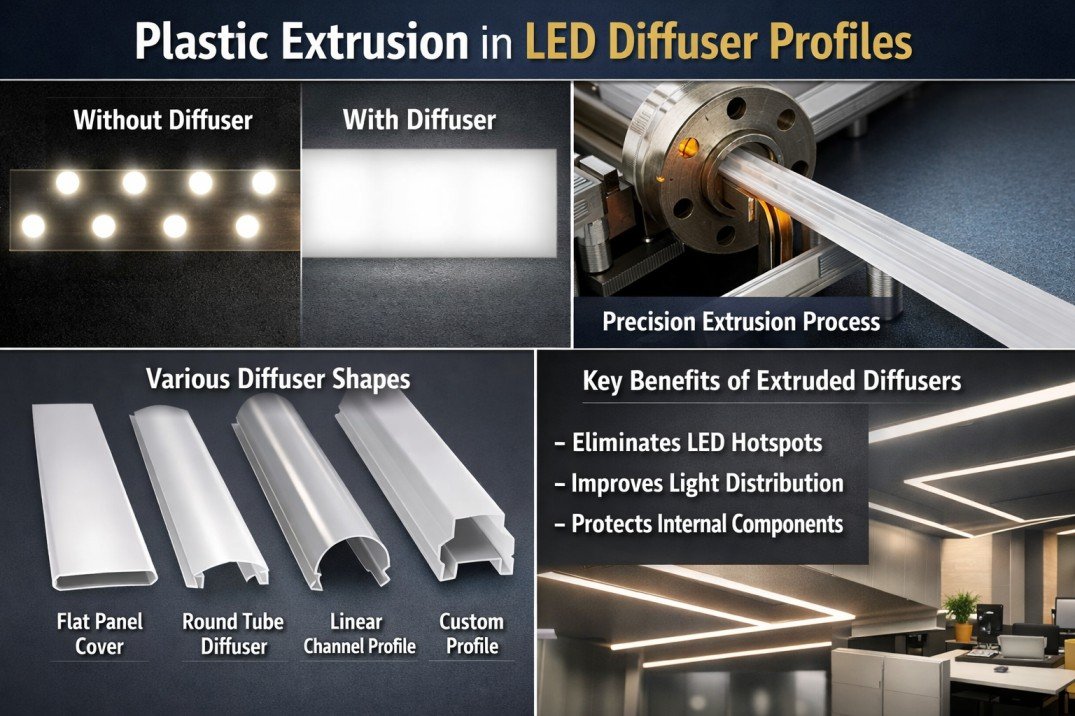
Without a diffuser, you would typically see individual LED points through the fixture. This is often called the dotting effect. Diffusers help eliminate this issue.
Common forms of LED diffusers include:
- Flat covers for panel lights
- Round or curved covers for tube lights
- Linear covers for architectural lighting
- Custom shapes for specialised lighting fixtures
Most modern lighting systems rely on plastic LED diffuser profiles because they are lightweight, easy to shape, and suitable for large-scale manufacturing.
Why Plastic Extrusion Is Used for LED Diffusers
Plastic extrusion is one of the most practical methods for producing diffuser profiles. The process pushes heated plastic through a shaped die to create continuous profiles with precise geometry.
For LED lighting manufacturers, this process offers several advantages.
Consistent Shape and Dimensions
Lighting fixtures often require precise fitting between aluminium housings, heat sinks, and diffuser covers. Extrusion ensures that every extruded LED diffuser profile matches the same dimensions, which is essential for assembly lines.
Efficient Production for Long Profiles
Linear lighting systems frequently use long diffuser covers. Plastic extrusion allows these profiles to be produced continuously and cut to required lengths without losing accuracy.
Flexible Design Possibilities
Extrusion dies can create many shapes, such as:
- curved diffuser covers
- snap-fit lighting covers
- channel diffuser profiles
- decorative architectural profiles
This flexibility makes plastic extrusion diffuser profile production suitable for many lighting designs.
Materials Commonly Used for LED Diffuser Profiles
Material choice is critical because it affects light transmission, durability, and heat resistance.
Below is a quick comparison of common materials.
Material | Key Benefits | Typical Applications |
Polycarbonate | High strength and heat resistance | Commercial lighting systems |
Acrylic | Excellent light clarity | Decorative lighting |
Frosted PVC | Good diffusion with lower cost | Standard fixtures |
Among these options, the polycarbonate LED diffuser profile is widely used in professional lighting systems because it offers strong impact resistance and stable performance under heat.
Lighting manufacturers also select materials based on the level of diffusion required.
How Diffuser Profiles Improve LED Lighting Performance
A diffuser does more than soften light. It directly affects the overall quality of a lighting system.
1. Eliminating Visible LED Points
A well-designed LED light diffuser plastic profile spreads the light so individual LED chips are no longer visible.
This produces:
- smoother illumination
- improved visual comfort
- a more professional appearance
2. Improving Light Distribution
Diffusers scatter light across a wider area. This helps create uniform brightness, especially in architectural and retail lighting.
3. Protecting Internal Components
The LED lighting diffuser cover also acts as a protective barrier. It shields LEDs from dust, accidental contact, and minor impacts.
4. Supporting Lighting Design
Diffuser profiles help control how light exits the fixture. By adjusting surface texture or material properties, designers can influence brightness levels and light spread.
Why Customisation Matters in LED Diffuser Profiles
Lighting manufacturers rarely use standard shapes. Each lighting product may require different dimensions or mounting styles.
That is why custom LED diffuser profile production is common in the industry.
Typical design factors include:
- profile width and height
- snap-fit locking systems
- diffusion level (clear, frosted, milky)
- compatibility with aluminium channels
For example, architectural lighting systems often use profiles designed specifically for aluminium housings.
In many projects, manufacturers require diffuser profiles used in linear LED lights to match precise channel dimensions. If the profile does not fit perfectly, installation becomes difficult and light quality can suffer.
Custom extrusion allows manufacturers to solve these design challenges early in the product development stage.
Real Manufacturing Considerations
In theory, producing diffuser profiles seems straightforward. In practice, several technical factors affect quality.
Die Design
The extrusion die determines the final profile shape. Even small design errors can lead to uneven wall thickness or dimensional instability.
Cooling Control
If cooling is uneven, the profile may warp or twist slightly. This is especially noticeable in long linear diffusers.
Diffusion Consistency
Manufacturers must carefully control material blends to achieve consistent light diffusion. A small change in additive concentration can alter how light spreads.
These production details explain why many lighting companies prefer working with specialised extrusion manufacturers.
For example, companies like M3 Extrusion focus on producing consistent diffuser profiles for lighting manufacturers that require stable quality across repeat orders.
Typical Applications of Extruded LED Diffuser Profiles
LED diffuser extrusion is used across many lighting sectors.
Common applications include:
- architectural linear lighting
- office lighting systems
- retail display lighting
- under cabinet lighting
- industrial task lighting
In these systems, the diffuser profile plays a major role in both appearance and light performance.
For instance, in retail environments, smooth light distribution helps highlight products without creating glare or harsh shadows.
Quick Summary
Here is a simple takeaway for manufacturers evaluating diffuser solutions.
Plastic extrusion is used in LED diffusers because it provides:
- consistent profile shapes
- scalable manufacturing for long profiles
- flexible custom designs
- stable light diffusion performance
These advantages explain the growing use of plastic extrusion in LED diffuser applications across commercial lighting industries.
FAQs
What is the purpose of a plastic LED diffuser profile?
A plastic LED diffuser profile spreads light from LED chips so the output appears smooth and uniform. It reduces visible LED points, improves visual comfort, and helps create balanced lighting across fixtures such as linear lights, panel lights, and architectural lighting systems.
Why is polycarbonate commonly used for LED diffuser profiles?
Polycarbonate is widely used because it offers strong impact resistance and high heat tolerance. It also maintains stable optical properties over time, which helps lighting systems deliver consistent diffusion and reliable performance even in demanding commercial environments.
How does plastic extrusion help in LED diffuser manufacturing?
Plastic extrusion allows manufacturers to produce long, consistent diffuser profiles with precise shapes. The process pushes heated plastic through a custom die, creating continuous profiles that can be cut to required lengths while maintaining uniform dimensions across large production batches.
What is the difference between clear and milky LED diffuser covers?
Clear diffuser covers allow more light transmission but provide less diffusion. Milky or frosted covers scatter light more effectively, which helps hide LED dots and produce smoother illumination. Lighting designers choose between them depending on brightness requirements and visual appearance.
Can LED diffuser profiles be customised for lighting systems?
Yes, most diffuser profiles are customised to match specific lighting fixtures. Designers adjust dimensions, mounting features, and diffusion levels to ensure proper fitting with aluminium channels and achieve the desired lighting effect.
Do diffuser profiles affect LED lighting efficiency?
Yes. The diffuser material and design influence how light spreads and how much brightness is lost during diffusion. A well-designed diffuser balances light transmission and diffusion so the fixture provides comfortable illumination without wasting too much output.
Are extruded LED diffuser profiles suitable for linear lighting?
Yes, extrusion is particularly suited for linear lighting systems. The process allows long, continuous diffuser profiles to be produced with consistent geometry, making them ideal for LED strips and architectural lighting channels used in commercial and industrial installations.