Whether you want to boost your façade’s energy efficiency or prevent condensation on façade glass, using warm edge spacers can be an ideal solution. Often called thermal edge spacers, these thin strips sit between glass panes to reduce heat loss at the edges.
Not only do they improve thermal performance, but they also help prevent fogging as well as water buildup, which can damage seals and shorten the lifespan of the façade. With warm edge spacers, indoor temperatures stay more even, making rooms near large windows more comfortable year-round.
They work effectively with double or triple glazing and are especially useful for large façades, curtain walls and modern high performance façade systems. By installing warm edge spacers, building owners can enhance comfort, save energy, and extend the life of their façade systems.
How Warm Edge Spacers Work in Façade Systems
Warm edge spacers are installed between glass panes in insulated windows and curtain walls to reduce heat loss at the edges, where energy escape is highest. Unlike traditional metal spacers, which transfer heat quickly as well as create cold spots, warm edge spacers from M3 Extrusion use PVC, a low-conductivity material that reduces heat transfer and improves insulation.
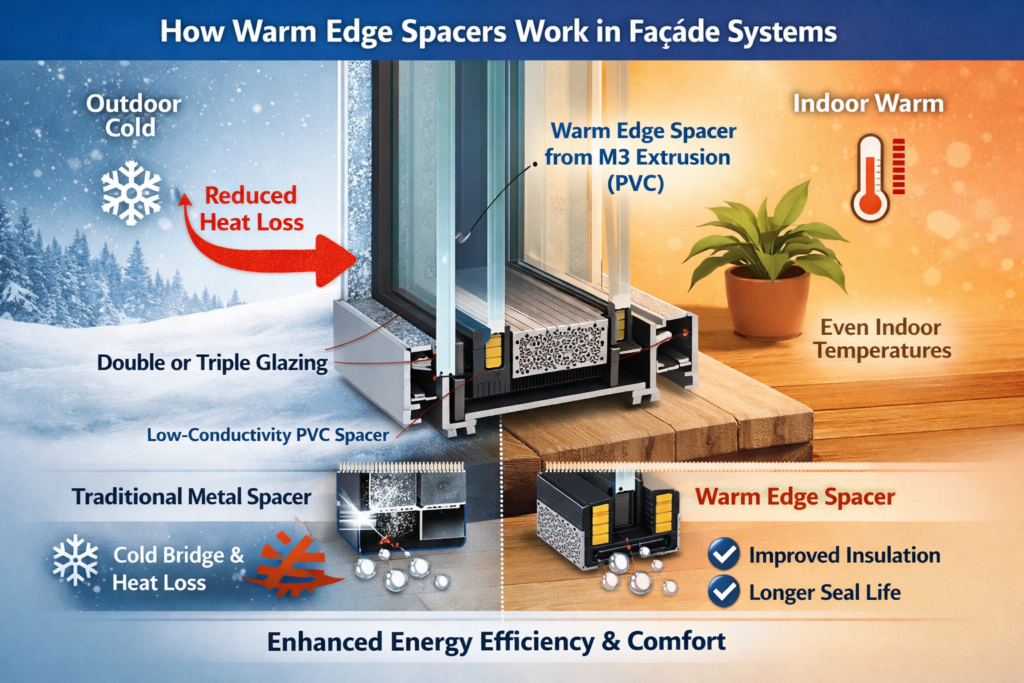
This slows heat flow, keeps indoor temperatures more even, and prevents condensation and fogging on the glass.
By reducing moisture buildup, they protect seals and extend the lifespan of the façade. Warm edge spacers work effectively with double or triple glazing and are especially useful in large façades and high performance façade systems, improving both energy efficiency and occupant comfort.
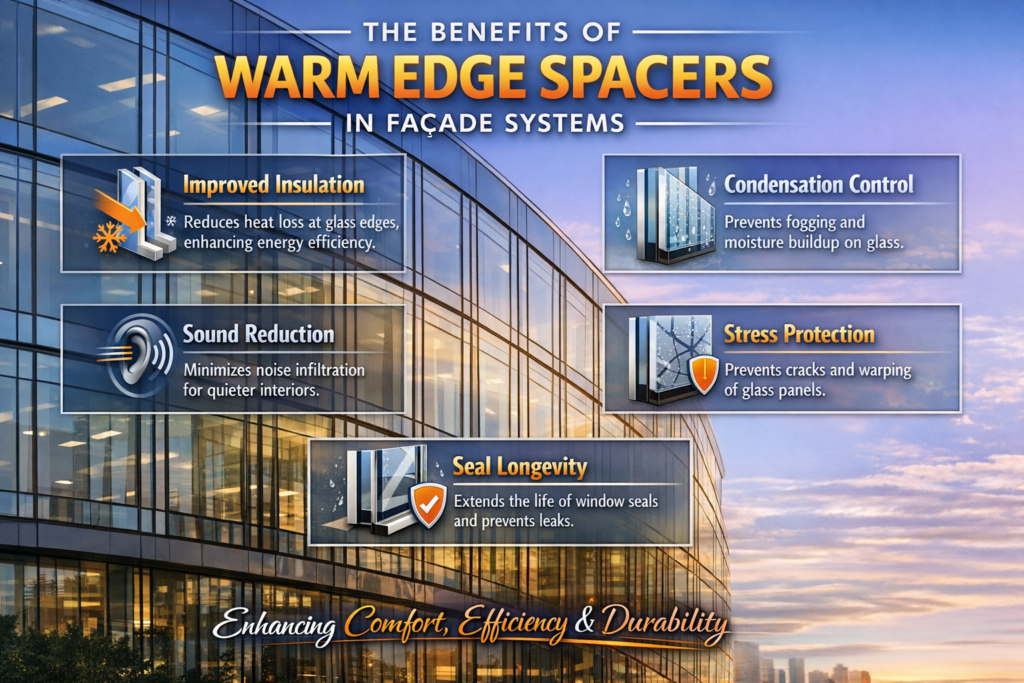
5 Uses of Warm Edge Spacers in Façade Systems
With warm edge spacers, façades not only control heat transfer at glass edges but also reduce condensation and moisture buildup. They help maintain the integrity of seals, preventing premature wear and the need for frequent repairs.
These spacers improve sound insulation by creating a tighter seal between panes, reducing noise from outside. They also support uniform temperature distribution across large glass surfaces, which helps prevent stress cracks and warping over time. Warm edge spacer technology for windows is widely used in façade systems to manage these performance requirements effectively.
In addition, warm edge spacers make façade maintenance easier by lowering the risk of water damage and glass staining. By managing temperature, moisture, and structural stress, they contribute to the long-term stability and performance of high performance façades.
Edge Insulation
With warm edge spacers, the edge of a glass pane can be insulated to control heat flow and maintain consistent conditions along the perimeter of the façade. This helps reduce heat loss at the edges, keeping indoor temperatures more stable and improving overall façade performance.
- Limits energy transfer: Warm edge spacers reduce heat movement at glass edges, keeping heated or cooled air inside and lowering the demand on HVAC systems.
- Protects window seals: By reducing temperature differences at the glass edges, spacers help seals stay intact as well as prevent leaks or condensation.
- Enhances efficiency: Because warm edge spacers support precise alignment and spacing of glass panes, they help windows perform reliably, ensuring smooth operation and long-term durability in façade systems.
By minimizing heat loss along window edges, warm edge spacers improve thermal performance, extend seal life, and reduce energy costs.
Condensation Management
In addition to insulating glass edges, warm edge spacers can also be used to manage condensation along the perimeter of façade glazing by controlling temperature differences. Positioned between glass panes, they control temperature variation along the glass perimeter where moisture commonly forms.
- Support façade assembly: By maintaining proper distance between glass panes, warm edge spacers help ensure correct alignment during installation, reducing areas where condensation could cause problems.
- Control moisture formation: With warm edge spacers, the edges of façade glass stay warmer, reducing condensation in areas where moisture tends to form.
- Support seal performance: By limiting moisture exposure at glass edges, warm edge spacers help seals maintain proper contact throughout daily façade use.
Overall, warm edge spacers help in controlling condensation at façade glass edges by managing temperature variation along the pane perimeter.
Acoustic Sealing
Since warm edge spacers maintain consistent spacing between glass panes, they can be used to reduce noise transmission through façade glazing. This placement creates a tighter seal between panes, reducing noise and enhancing the acoustic comfort of interior spaces.
- Create a tighter seal: Warm edge spacers keep glass panes evenly spaced, reducing gaps that allow sound to pass through the façade.
- Support multi-pane glazing: By maintaining proper alignment, spacers help windows and curtain walls retain their acoustic performance over time.
- Integrate with façade design: Warm edge spacers can be incorporated into large glazing units or curtain walls to improve sound insulation without affecting the visual design.
By maintaining proper pane spacing and alignment, warm edge spacers help façades reduce noise transmission and keep glazing units stable.
Stress Distribution
Using warm edge spacers, stress can be controlled across glass panels to prevent cracking or warping in façade systems. Properly positioned spacers help maintain even spacing and alignment, allowing panes to expand as well as contract safely under temperature changes.
- Control thermal stress: Warm edge spacers help keep glass panels evenly heated, which prevents uneven expansion that can lead to stress fractures.
- Maintain structural integrity: By keeping panes properly aligned, spacers help glazing units withstand wind loads and building movement without compromising their performance.
- Reduce edge pressure: Warm edge spacers help distribute forces evenly along glass edges, minimizing localized stress that can lead to cracks.
Warm edge spacers help façades distribute stress evenly, reducing the risk of damage and extending the lifespan of glazing units.
Seal Protection
Because warm edge spacers regulate spacing and edge conditions, they can support seal durability and reduce the risk of leaks in façade glazing units.
- Maintain seal alignment: Spacers keep glass panes properly positioned, ensuring seals stay in contact with the frame and edges.
- Reduce stress on seals: By limiting temperature differences along glass edges, warm edge spacers prevent cracks or deformation in seal materials.
- Extend glazing lifespan: Proper seal protection helps façades remain watertight and lowers the need for maintenance over time.
Warm edge spacers help façades maintain seal integrity, protecting glazing units from leaks and supporting long-term durability.
Conclusion
Over the years, warm edge spacers have become a key component of high performance façade systems, enhancing energy efficiency, maintaining structural stability as well as supporting long-term durability. They help control condensation, distribute stress, protect seals and improve acoustic performance across glazing units.
By keeping glass panes properly aligned and spaced, warm edge spacers contribute to reliable window operation and reduced maintenance needs.
For modern façades with large glazing areas, double or triple glazing, and curtain walls, using warm edge spacer technology ensures façades perform efficiently, remain durable, and provide comfortable, safe indoor environments for building occupants.
Are you looking for warm edge spacers to improve the performance and durability of your façade glazing? M3 Extrusion offers high-quality warm edge spacer PVC profiles for industrial applications, helping reduce maintenance, enhance energy efficiency, and maintain stable indoor conditions.
Frequently Asked Questions
How do warm edge spacers reduce condensation on façades?
Condensation occurs when warm indoor air touches cold glass edges on façades. Warm edge spacers slow heat transfer at these edges, keeping glass warmer, reducing fogging, minimizing water buildup, and protecting window seals, which helps maintain façade performance over time.
Do warm edge spacers require special maintenance?
Warm edge spacers do not require special maintenance. Regular cleaning of glass surfaces and standard inspection of window seals is sufficient. Proper care ensures continued protection against condensation and preserves the performance and lifespan of façade systems.
Are warm edge spacers suitable for large glass façades?
Warm edge spacers are effective for large windows and curtain walls, where edge heat loss is higher. These spacers help maintain even temperatures across the glass, reduce stress on seals and panes, and prevent condensation and structural damage.
Do warm edge spacers affect façade appearance?
Warm edge spacers help maintain a cleaner look on façades by reducing fogging and condensation. Clear, even glass surfaces remain visible, preserving aesthetic appeal and ensuring that large glass panels and curtain walls continue to look polished over time.