If you have ever worked on a lighting project where the first batch looked perfect but the next one did not match, you already know why diffuser selection matters. In industrial and commercial lighting, consistency is not a nice extra. It is a requirement. This guide is written for buyers, designers, and production teams who deal with repeat orders, drawings, and project deadlines, not one off retail lighting.
Choosing the right white LED diffuser in India is about more than colour and brightness. It affects light output, assembly speed, rejection rates, and long-term performance on site.
What Is a White LED Diffuser and Why It Matters
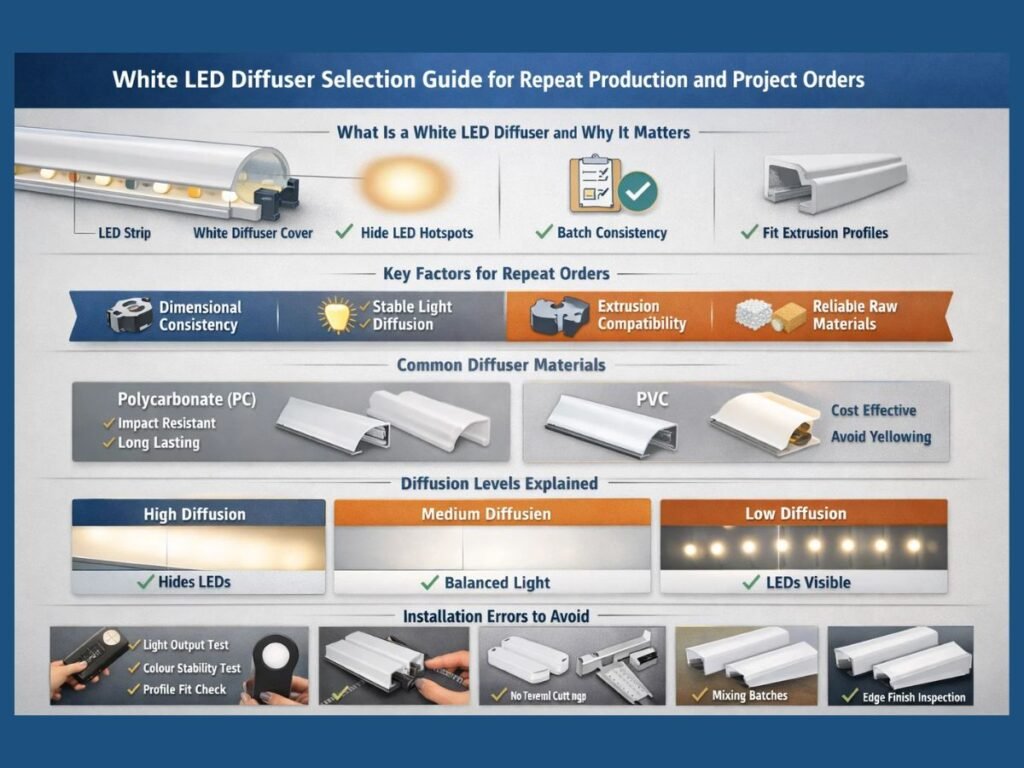
A white LED diffuser is a plastic cover fitted over LED strips or linear lighting systems. Its main role is to soften the light, reduce glare, and create uniform illumination.
In real projects, diffusers also need to:
- Hide LED hotspots consistently
- Match the same appearance across batches
- Fit extrusion profiles without stress or gaps
For project-based and repeat production work, small variations in diffuser quality can lead to visible differences once installed across large areas.
Why Repeat Production Needs a Different Selection Approach
Many buyers make the mistake of choosing a diffuser based only on a sample. Samples rarely show how the material behaves over long runs.
When sourcing a white LED diffuser in India for ongoing supply, you should think in terms of systems, not pieces.
Key factors for repeat orders
- Dimensional consistency across batches
- Stable light diffusion from lot to lot
- Compatibility with extrusion tolerances
- Reliable raw material sourcing
A diffuser that works well once but changes shade or fit later can slow down production and increase rework.
Common Materials Used for White LED Diffusers
The material choice directly affects diffusion, durability, and ageing.
Polycarbonate (PC)
Used where impact resistance and long life are important.
- Good light diffusion with proper formulation
- Resists cracking during installation
- Suitable for commercial and industrial environments
PVC
Used in controlled indoor applications.
- Cost-effective for large volumes
- Easy to process in extrusion
- Needs careful formulation to avoid yellowing
For long-term projects, always ask how the material performs after months of continuous lighting.
Light Diffusion Levels and Visual Output
Not all white diffusers produce the same effect, even if they look similar.
Diffusion types explained simply
- High diffusion
Hides LED dots well but slightly reduces brightness - Medium diffusion
Balances light output and uniformity - Low diffusion
Higher brightness but LED points may be visible
For offices, retail ceilings, and workspaces, medium to high diffusion is usually preferred.
Matching Diffuser Design with Extrusion Profiles
One issue seen often during installation is a diffuser that technically fits but creates stress on the profile.
This usually happens when:
- The diffuser wall thickness is inconsistent
- The snap fit tolerance is too tight
- Material flexibility is not considered
For repeat production, diffuser and aluminium or plastic profiles must be designed together. This reduces installation time and avoids cracking during fitting.
Errors to Avoid During LED Diffuser Installation
Even a good diffuser can fail if installed incorrectly.
Common installation errors
- Forcing diffusers into profiles instead of sliding
- Cutting diffusers with blunt tools, causing uneven ends
- Installing without allowing for thermal expansion
- Mixing diffusers from different batches in one project
These mistakes lead to visible joints, cracking, or uneven lighting across the installation. For proper guidance, read: Common Mistakes to Avoid When Installing a White LED Diffuser
Practical tip from the field
Always test fit diffusers from the same production batch before full scale installation. This simple step avoids costly corrections later.
Environmental Conditions in Indian Projects
Indian operating conditions are not mild, especially in commercial spaces.
When selecting a white LED diffuser in India, consider:
- High ambient temperatures
- Long daily operating hours
- Dust and indoor pollutants
- Power fluctuation heat buildup
Diffusers must hold colour and diffusion performance without warping or discolouration.
Quality Checks Before Approving Bulk Orders
Before confirming large quantities, do not rely on visual checks alone.
What to verify
- Light output consistency under the same LED source
- Colour stability after continuous lighting tests
- Fit consistency across multiple profiles
- Edge finish quality after cutting
A short pilot run often reveals issues that a single sample cannot.
Why Manufacturers Prefer Drawing-Based Diffuser Supply
For serious projects, diffusers are not generic components. They are part of a lighting system.
Manufacturers who supply diffusers based on:
- Technical drawings
- Defined tolerances
- Fixed material grades
help reduce variation across production cycles.
This approach supports long-term project continuity and predictable assembly outcomes.
Working with the Right Manufacturing Partner
In repeat production, supplier capability matters as much as material choice. A manufacturer like M3 Extrusion supports diffuser profiles designed for consistent output, batch control, and project based supply. This helps lighting manufacturers maintain uniform results across installations without redesigning systems for every order.
Key Takeaways for Buyers and Project Teams
- Choose diffusers based on production needs, not samples
- Match diffuser design with profile tolerances
- Avoid mixing batches during installation
- Plan for Indian operating conditions
- Always validate before bulk approval
These steps reduce field issues and support smooth project execution.
Frequently Asked Questions
What is the ideal white LED diffuser for repeat production?
The ideal diffuser offers stable light diffusion, consistent dimensions, and reliable material quality across batches. It should fit profiles without stress and maintain the same visual output in every production run, even when orders are spaced months apart.
How do I prevent colour variation in white LED diffusers?
Prevent colour variation by sourcing from a manufacturer that controls raw material formulation and batch consistency. Always approve a reference sample and ensure future production matches the same material grade and diffusion specification.
Are white LED diffusers suitable for long operating hours?
Yes, when made from suitable materials like polycarbonate or properly formulated PVC. The diffuser must resist heat buildup and maintain colour stability under continuous lighting conditions common in commercial and industrial installations.
What installation mistakes reduce diffuser lifespan?
Common mistakes include forcing diffusers into profiles, ignoring thermal expansion, and cutting with improper tools. These issues can cause cracking, uneven lighting, and early failure, even if the diffuser quality is otherwise good.
Can the same diffuser be used across different projects?
Only if profile dimensions, LED spacing, and light output requirements are similar. For consistent results, it is better to standardise diffuser specifications for each project type and avoid mixing designs across different installations.
Why is batch control important for LED diffuser supply?
Batch control ensures that every diffuser produced matches the approved reference in colour, diffusion, and fit. This is essential for large projects where visual consistency across multiple areas matters.
Check related articles for more insights: